Advanced Measurement Techniques and Control Algorithms for Blow-up Ratio in High-Speed Lines 2026
In high-speed blown film lines (150-300 m/min), manual measurement of lay-flat width is impractical, so online sensors are used for continuous BUR control. The most common sensor is the ultrasonic width gauge, which uses two transducers to measure the distance to the film edges, providing a continuous width reading. Optical sensors (line scan cameras) are also used, offering high accuracy and the ability to detect edge defects. The sensor is typically installed just after the nip rolls, where the film is flat. The width reading is sent to the PLC, which compares it to the target width and calculates the required internal pressure adjustment. The control algorithm is usually a PID loop with feedforward from line speed: when speed increases, the bubble tends to narrow (neck-in), so the pressure is increased proactively. The PID gain must be tuned to avoid oscillation; a deadband (e.g., ±2 mm) prevents unnecessary adjustments. The control loop update rate is typically 1-2 seconds. In summary, online measurement and automatic control of BUR are essential for high-speed lines. The sensor must be calibrated regularly and protected from dust. The operator monitors the control performance and can manually override if needed. The algorithm must account for the time delay between pressure adjustment and width change (bubble response time, typically 10-30 seconds). Advanced systems use model predictive control (MPC) that predicts the width response and adjusts pressure optimally. In practice, the BUR control system is integrated with the thickness gauge AGC and the winder tension control, ensuring coordinated operation.
The accuracy of the online width sensor is critical; it must be calibrated against a manual measurement periodically. The sensor's output may be affected by film fluttering or dust; a stabilization bar or air knife can help. The control algorithm should also include a ramp limiter to prevent sudden pressure changes that could disturb the bubble. In multi-layer lines, the BUR control is the same for all layers, but the internal pressure must be stable to maintain layer ratios. The operator should set the target BUR based on the product recipe; the system then maintains it automatically. In case of sensor failure, the system should alarm and revert to manual control. In conclusion, advanced BUR measurement and control are key enablers of high-speed, high-quality blown film production, reducing operator workload and improving consistency. Regular maintenance of the sensor and tuning of the control loop are essential for reliable performance.
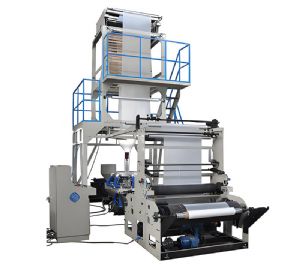
Blown Film Machine
Sensor technologies: Ultrasonic: non-contact, measures distance to edges, works well for opaque films. Optical: line scan camera, higher accuracy, can detect edge defects. Laser triangulation: precise but more expensive. Installation: place after nip, before winder, with film flat and stable. Calibration: use a physical ruler or known width sample; adjust sensor offset. Control algorithm: PID with feedforward from line speed; gain tuned for bubble response time. Deadband: 1-3 mm to avoid chattering. Update rate: 1-2 seconds. Safety: alarm if sensor reading out of range; revert to manual. Integration: with line speed, extruder output, and AGC for coordinated control. Tuning tips: Start with conservative gain, increase until oscillation, then reduce by 30%. Set integral time to match bubble response (20-30 s). Use derivative to dampen overshoot (low value). In practice, the BUR control system is a valuable tool for maintaining consistent lay-flat width, reducing scrap from width variations. The operator should regularly review control logs and adjust tuning if needed. In conclusion, advanced measurement and control of BUR enable high-speed lines to produce film with consistent width and properties, enhancing overall efficiency and product quality.
