Advanced Mathematical Modeling of Blow-Up Ratio and Its Interaction with Cooling and Orientation 2026
The blow-up ratio (BUR) is a dimensionless parameter that fundamentally influences the stress and strain history of the polymer film. The bubble is a thin shell subjected to internal pressure, and its shape is determined by the force balance: the pressure difference (ΔP) is balanced by the surface tension and the viscous stresses in the film. The stress in the circumferential direction (TD) is proportional to ΔP × R_bubble / (2 × thickness), while the stress in the machine direction (MD) is related to the haul-off force divided by the cross-sectional area. The BUR determines the TD strain: the film's circumference is stretched from π × Die Diameter to π × Bubble Diameter, so the TD stretch ratio is BUR. The MD stretch ratio is given by the draw-down ratio (DDR), which is the ratio of the haul-off speed to the melt exit speed. The final film thickness is inversely proportional to BUR × DDR. The orientation of polymer chains is determined by these stretch ratios; higher stretch leads to more molecular orientation, which increases strength in that direction. The cooling rate, which is influenced by the air ring and IBC, affects the relaxation of oriented chains; faster cooling freezes orientation, while slower cooling allows relaxation. Therefore, the final film properties depend on the interaction of BUR, DDR, and cooling rate. A mathematical model of bubble formation, based on the equations of conservation of mass, momentum, and energy, can predict the bubble shape, stress distribution, and temperature profile. These models are used in process simulation to design dies and optimize operating conditions. The model inputs include die diameter, BUR, DDR, melt temperature, cooling air flow, and resin rheological properties. The outputs include film thickness, stress, and temperature distribution. The model can also predict the onset of instability by analyzing the bubble's response to small perturbations. In summary, the mathematical modeling of BUR provides a powerful tool for understanding the complex interplay between process parameters and film properties. It enables virtual experimentation, reducing the need for costly trial runs.
The interaction between BUR and cooling is particularly critical. The cooling air removes heat from the bubble surface, and the cooling rate decreases as the film moves upward (away from the air ring). The frost line is the point where the film temperature drops below the crystallization temperature. The BUR determines the film thickness at any height; for a given output, a higher BUR results in thinner film, which cools faster (because the thermal resistance is lower). Therefore, a higher BUR tends to lower the frost line, allowing higher line speeds. However, the thinner film also has lower mechanical strength at the molten state, making it more prone to instability. The cooling air flow must be adjusted to maintain the frost line at a stable height; typically, a higher BUR requires more cooling air to maintain the same frost line height as a lower BUR. The IBC adds another dimension: internal cooling reduces the temperature gradient, allowing more uniform solidification. The interaction between BUR and IBC is synergistic; IBC allows a higher BUR without increasing the external cooling load, thus enabling high-strength films at high speeds. In summary, the BUR cannot be optimized in isolation; it must be considered together with cooling and DDR. The mathematical models that capture these interactions are essential for advanced process control and product development. By using these models, converters can predict the effect of BUR changes on film properties and stability, and quickly find the optimal operating point. In conclusion, the advanced mathematical modeling of BUR provides a scientific foundation for process optimization. It enables a deeper understanding of the blown film process, leading to better quality, higher output, and reduced scrap. As computational tools become more accessible, their use in blown film production will become standard practice.
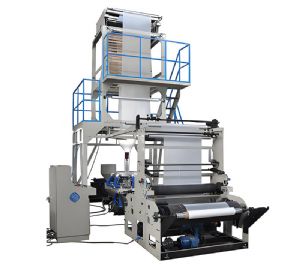
Blown Film Machine
Key equations: – TD stretch = BUR – MD stretch = DDR – Thickness ∝ 1 / (BUR × DDR) – Stress_TD = ΔP × R / (2 × t) – Stress_MD = F_haul / (2 × π × R × t) – Frost line position determined by energy balance: heat removal = heat content. – Instability criterion: when the bubble's natural frequency becomes undamped. Model inputs: die geometry, melt properties (viscosity, density, thermal conductivity), cooling air properties, line speed. Model outputs: bubble profile, thickness distribution, stress distribution, temperature profile. Validation: compare model predictions with measured film properties. Application: optimize BUR and cooling for a new resin or product. In conclusion, modeling is a powerful tool that complements experimental optimization. It reduces the time and cost of process development, and helps operators understand the underlying physics, leading to more informed decisions and better process control.
