Advanced Maintenance Strategies for Blown Film Equipment: Predictive and Condition-Based Approaches 2026
Traditional preventive maintenance (fixed intervals) is often inefficient – either too frequent (wasting parts and labor) or too infrequent (causing unexpected failures). Predictive maintenance (PdM) uses real-time condition monitoring to determine when maintenance is actually needed, optimizing resources and minimizing downtime. For blown film equipment, key PdM technologies include vibration analysis, oil analysis, thermography, and motor current signature analysis. Vibration sensors (accelerometers) mounted on gearboxes, blowers, and winder bearings can detect early signs of wear, imbalance, or misalignment. The vibration data is analyzed for changes in amplitude and frequency spectrum; an increase in vibration at the gear mesh frequency indicates gear wear. Oil analysis of the gearbox oil measures particle count, viscosity, and acid number; a sudden rise in wear particles indicates impending bearing or gear failure. Thermography (infrared cameras) can detect hot spots in electrical panels, heater bands, and bearings, indicating loose connections or failing components. Motor current signature analysis detects anomalies in the current waveform that indicate rotor bar cracks or bearing defects. These technologies allow maintenance to be scheduled during planned downtime, avoiding unexpected stoppages. The implementation of PdM requires an initial investment in sensors, data acquisition systems, and software, but the payback is typically 1-2 years through reduced downtime and extended equipment life. In summary, predictive maintenance transforms maintenance from a cost center to a value-adding function by reducing unplanned downtime and optimizing spare parts usage.
Condition-based maintenance (CBM) is a subset of PdM where maintenance is performed when a parameter exceeds a predefined threshold. For example, if the vibration velocity exceeds 4.5 mm/s (ISO 10816-3), then a bearing replacement is scheduled. The thresholds are established based on historical data and manufacturer recommendations. CBM is more advanced than time-based maintenance but simpler than full PdM. For blown film equipment, CBM can be applied to critical components: the thrust bearing's temperature (if >80°C, schedule inspection), the gearbox oil pressure (if drops by 20%, check filter), the blower's motor current (if increases by 10%, check for blockages). The CBM system can be integrated with the plant's SCADA, providing alerts to operators. The operator then decides on the action, based on the production schedule. The advantage of CBM is that it balances reliability and cost – maintenance is done only when necessary, but not too late. To implement CBM, the plant must have a clear set of parameters and thresholds, and the operators must be trained to respond. The use of data logging and trend analysis helps refine thresholds over time. In summary, predictive and condition-based maintenance are powerful strategies for blown film equipment. They reduce unplanned downtime by up to 70% and extend equipment life by 20-30%. The investment in sensors and software is justified by the savings in lost production and reduced repair costs. In conclusion, modern blown film plants should adopt these advanced maintenance approaches to stay competitive. By moving from reactive to proactive maintenance, converters can achieve higher OEE and lower total cost of ownership. This requires a cultural shift from "fix it when it breaks" to "monitor and prevent," but the benefits are substantial and measurable.
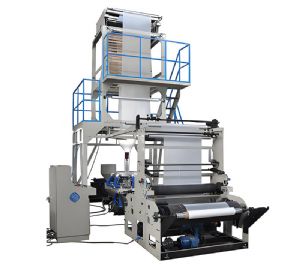
Blown Film Machine
Key monitoring points: – Gearbox: vibration (velocity), oil temperature, oil pressure, particle count. – Extruder screw: motor current, melt pressure, axial thrust (strain gauge). – Barrel heaters: current draw, temperature deviation. – Blower: vibration, motor current, air flow (differential pressure). – Winder: bearing temperature, tension deviation. – Electrical panels: thermal imaging for hot spots. – Cooling water: flow rate, temperature, pressure. The data from these points should be collected and stored in a historian for trend analysis. Predictive algorithms (e.g., machine learning) can be applied to forecast failures. The maintenance team should review the data weekly and plan interventions. Spare parts should be stocked based on the criticality of each component. In conclusion, the adoption of predictive and condition-based maintenance transforms the blown film plant into a more reliable and efficient operation. It requires an initial investment in technology and training, but the long-term benefits far outweigh the costs. With the increasing integration of IoT and Industry 4.0, these strategies are becoming more accessible and affordable, making them a standard practice for leading converters.
