Advanced Machine Learning and AI for Real-Time Process Optimization in Blown Film 2026
Machine learning (ML) and AI are increasingly applied to blown film extrusion for real-time process optimization and quality prediction. Unlike static DOE, ML models can be updated continuously with production data, adapting to resin variations and machine drift. The process data (temperatures, pressures, speeds, thickness profile) is collected via sensors and fed into a ML model (e.g., neural network, random forest) that predicts the film properties (haze, tear, thickness) in real-time. The model is trained on historical data with measured properties. Once validated, the model can be used for predictive control: the system adjusts the process parameters (e.g., cooling, BUR) proactively to keep the predicted properties within specification. This is a form of model predictive control (MPC) with a ML-based process model. The benefits include tighter quality control, reduced scrap, and faster response to disturbances. In practice, implementing ML requires a robust data infrastructure (sensors, data historians) and a team with data science skills. The model must be retrained periodically to maintain accuracy. In summary, ML and AI offer a powerful approach to dynamic process optimization, going beyond static DOE to provide adaptive, real-time control. Converters who adopt this technology can achieve higher consistency and efficiency, gaining a competitive edge. In conclusion, advanced machine learning and AI are transforming blown film production, enabling real-time optimization that improves quality and reduces waste, making them a strategic investment for the future.
The implementation of ML for blown film typically starts with a data collection phase (1-3 months) to build a sufficient dataset. Feature engineering is important: selecting relevant variables and creating derived features (e.g., moving averages). The model is trained and validated on a hold-out set. Then it is deployed on an edge device (industrial PC) that interfaces with the PLC. The control system uses the model's predictions to adjust setpoints. The operator has an override capability. In practice, the ML model can also be used for anomaly detection: identifying unusual process conditions that could lead to defects. In conclusion, advanced ML and AI are the next frontier in extrusion process optimization, offering the potential for near-autonomous, self-optimizing blown film lines that deliver consistent quality with minimal scrap.
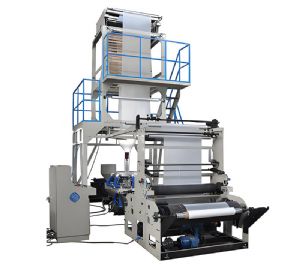
Blown Film Machine
ML implementation steps: 1) Data collection: sensors, historians, quality lab. 2) Data preprocessing: cleaning, normalization. 3) Feature engineering: create relevant variables. 4) Model selection: neural network, random forest, etc. 5) Training and validation. 6) Deployment on edge device. 7) Integration with PLC for control. 8) Continuous retraining and monitoring. Key data sources: Barrel and die temperatures. Melt pressure. Screw speed. Line speed. Cooling air flow and temperature. Thickness gauge profile. Resin properties (MFI, density). Benefits: Real-time quality prediction. Proactive parameter adjustment. Reduced scrap. Faster changeovers. Anomaly detection. Challenges: Data quality and quantity. Model maintenance. Integration with existing control systems. In practice, the investment in ML/AI can be significant, but the payback through reduced scrap and improved quality can be substantial. In conclusion, advanced ML/AI for real-time process optimization is a cutting-edge technology that can significantly enhance blown film production efficiency and quality, making it a worthwhile investment for high-volume, high-quality converters.
