Advanced Line Balancing and Throughput Optimization in Blown Film Manufacturing Lines 2026
The blown film manufacturing line is a complex system of interconnected components, and its overall output is determined by the slowest component – the bottleneck. To achieve optimal throughput, each component’s capacity must be matched to the target output. The primary bottleneck is often the cooling system, because the extruder can usually produce more melt than the air ring can solidify. Therefore, the line's maximum output is limited by the cooling capacity: the ability to remove heat from the bubble to maintain a stable frost line. To balance the line, one must first measure the maximum output of each component: extruder (kg/h at maximum screw speed without degradation), cooling system (maximum line speed for a given thickness and width), winder (maximum speed and roll handling capacity), and downstream equipment (slitter, bag machine). The lowest of these becomes the line's practical capacity. For example, if the extruder can do 400 kg/h, but the cooling can only handle 350 kg/h for the target film, then the line's max is 350 kg/h. To increase throughput, the bottleneck must be eliminated or upgraded – e.g., by adding IBC or chilled air to increase cooling capacity. Line balancing also involves synchronizing speeds: when the line speed changes, all drives (extruder, haul-off, winder) must change proportionally to maintain constant thickness and tension. This is achieved by a master speed reference. The line's control system should also manage the transition between products; during changeover, the line speed is reduced to minimize scrap. In summary, line balancing is a systematic approach to identify and eliminate bottlenecks, ensuring that the blown film manufacturing line operates at its maximum potential. Regular audits of component capacities and process conditions are necessary to maintain balance as equipment wears or resin changes. A well-balanced line can achieve OEE >90%, significantly improving profitability.
Throughput optimization extends beyond component capacities to include operating strategies. For example, running the line at the highest possible speed reduces the specific energy consumption (kWh/kg) and labor cost per kg, but may increase scrap if quality deteriorates. Therefore, the optimal throughput is where the marginal cost of scrap equals the savings from higher output. This can be determined by a cost model that includes energy, labor, material, and scrap. The use of design of experiments (DOE) can identify the parameter set that maximizes throughput while maintaining quality. For instance, increasing BUR may allow higher speed (because the film is thinner), but it may reduce tear strength. The operator must find the sweet spot. The line's control system can also implement adaptive control that continuously adjusts parameters to maintain quality at maximum speed. Data from the thickness gauge and other sensors is used to detect any deviation, and the system slows down if necessary to prevent scrap. In summary, throughput optimization is a dynamic process that balances speed, quality, and cost. It requires a deep understanding of the process and real-time data. By implementing advanced control strategies and regular performance reviews, converters can push their lines to the limit without compromising quality. In conclusion, the blown film manufacturing line is a system that must be carefully balanced and optimized to achieve its full potential. The combination of component matching, speed optimization, and adaptive control ensures that the line produces high-quality film at the lowest possible cost, providing a competitive edge in the market.
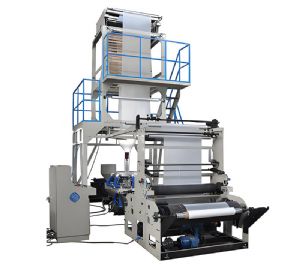
Blown Film Machine
Key steps for line balancing: 1) Measure the maximum output of each component at the target film specifications. 2) Identify the bottleneck – the component with the lowest capacity. 3) Upgrade or adjust the bottleneck (e.g., add IBC, increase blower speed, upgrade winder). 4) Re-measure and verify the new balance. 5) Implement a master speed control to synchronize all drives. 6) Monitor and adjust regularly as conditions change. For throughput optimization: – Use DOE to find optimal operating parameters. – Implement adaptive control to maintain quality at high speed. – Monitor scrap rate and energy consumption. – Adjust speed based on real-time quality feedback. – Train operators to recognize when to reduce speed to avoid defects. In conclusion, line balancing and throughput optimization are essential for achieving high efficiency and profitability in blown film manufacturing. They require a systematic, data-driven approach and a commitment to continuous improvement. With the right tools and mindset, converters can significantly increase their output and reduce costs, ensuring long-term success.
