Advanced Layer Ratio Control and Feed Block Design for Multi-Layer Co-extrusion 2026
In multi-layer co-extrusion, the layer ratio (the percentage of total thickness contributed by each layer) must be controlled precisely to achieve the desired functional properties. The layer ratio is determined by the relative throughput of each extruder, which is set by the screw speeds and melt pump speeds. However, the feed block and die design also influence the final layer distribution. In a feed block, the melt streams from each extruder are combined into a single stratified flow, which then enters the die and is expanded into an annular shape. The feed block's flow channels must be designed to ensure that the layers remain distinct and uniform across the width. The layer thickness distribution can be affected by the channel geometry, the viscosity of each layer, and the flow rate. For example, a high-viscosity layer will tend to stay in the center of the channel, while a low-viscosity layer will migrate to the wall (the "viscous encapsulation" effect). To counteract this, the feed block may have flow dividers or adjustable restrictor bars to balance the flow. In multi-manifold dies, each layer has its own spiral mandrel, and the layers are combined only near the die exit. This allows independent temperature control and better layer uniformity, but the die is more complex and expensive. The layer ratio is typically set during recipe management; the control system calculates the required extruder speeds based on the target ratios and the measured outputs. In summary, precise layer ratio control requires a combination of accurate feeding systems, well-designed feed blocks or dies, and robust control algorithms. Regular calibration of the gravimetric feeders and verification of layer thickness using NIR gauging are essential for maintaining product consistency.
The feed block design is critical for achieving uniform layer distribution. The flow channels must be designed to minimize pressure drops and avoid stagnation zones, which can cause degradation and gels. The channel dimensions are calculated based on the flow rates and viscosities of the layers. The use of computational fluid dynamics (CFD) is common to optimize the feed block geometry. The feed block also includes a "stack" of plates, each with a channel for one layer; the plates are assembled to form the complete flow path. The feed block is heated to the melt temperature; thermal expansion must be accounted for in the design. The feed block is typically located before the die; for large dies, the feed block may be integrated with the die. In multi-manifold dies, the layer ratio is controlled by the individual extruder outputs, but the die's mandrel dimensions also affect the layer thickness profile. The die must be designed to distribute each layer uniformly around the circumference; any asymmetry causes gauge bands. The die's heating system must maintain a uniform temperature to prevent viscosity variations. In summary, the feed block and die are precision components that must be engineered for the specific layer structure and resins. Their design directly affects the layer ratio accuracy and film quality. Regular maintenance, including cleaning and inspection, is essential to prevent flow imbalances. In conclusion, advanced layer ratio control and feed block design are key technologies for producing high-quality multi-layer films. By ensuring precise layer distribution, converters can achieve the desired functional properties and material efficiency.
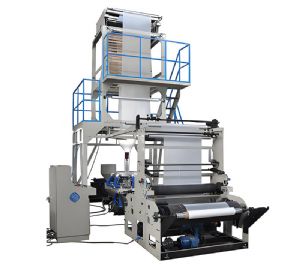
Blown Film Machine
Key design parameters for feed block: – Channel dimensions (width, height, length) based on flow rates. – Viscosity ratio of adjacent layers; use tie layers to reduce mismatch. – Thermal expansion compensation. – Heating zones to maintain uniform temperature. – Pressure drop across each channel should be balanced. – Adjustable restrictors for fine-tuning. – Material: stainless steel with polished surfaces. For multi-manifold dies: – Each layer has a separate spiral mandrel. – Layer combination occurs near the die lip. – Independent temperature control for each mandrel. – More complex but better for high layer counts. – More expensive and requires more maintenance. Control of layer ratio: – Use gravimetric feeders for accurate output. – Melt pumps to decouple pressure from screw speed. – NIR gauging for real-time layer thickness measurement. – Closed-loop control adjusting extruder speeds based on NIR feedback. – Recipe management for automatic changeover. In practice, the layer ratio accuracy can be maintained within ±1% with good equipment and control. This is essential for barrier films where the barrier layer thickness directly determines oxygen transmission rate. In conclusion, the feed block and die are the enablers of multi-layer technology; their design and operation are critical for achieving consistent film quality.
