Advanced Layer Configuration and Interfacial Stability in Multi-Layer Co-extrusion Blown Film 2026
The number of layers in a blown film co-extrusion line is a strategic decision that directly influences the film's functional properties, processability, and cost. Single-layer films are the simplest, using one extruder and one melt stream, but they are limited to a single polymer or blend, which cannot provide the combination of sealability, barrier, and toughness required for advanced packaging. Three-layer structures (e.g., A/B/A or A/B/C) are the most common entry-level multi-layer, allowing a sealant layer (inner), a core layer (often with recycled content or filler), and an outer layer (for printability or strength). Five-layer films add two tie layers, enabling the incorporation of a barrier resin (EVOH or PA) between incompatible polyolefins, which is essential for oxygen-sensitive food packaging. Seven-layer films further refine the structure, allowing multiple barrier layers or the use of reclaimed materials in a separate core layer without affecting surface properties. Nine-layer films are the pinnacle, offering extreme flexibility for complex structures with multiple barriers, sealants, and structural layers, often used in medical and high-performance industrial films. The choice of layer count must consider the rheological compatibility of adjacent layers; mismatched viscosities or elasticities can cause interfacial instability, leading to wavy interfaces or delamination. The die design for each layer count is different: feed block dies are common for up to 5 layers, while multi-manifold stack dies are preferred for 7+ layers because they allow independent temperature control and better layer distribution. In summary, the number of layers is a balance between performance requirements and capital investment, with each additional layer adding complexity and cost but also enabling higher value products.
Interfacial stability in multi-layer co-extrusion is governed by the ratio of the layer thicknesses and the viscosity ratio of the adjacent polymers. The critical condition for stability is that the viscosity ratio (η_1/η_2) should be close to 1, and the elasticity ratio should be matched. When the viscosity ratio deviates significantly, the interface can develop waves (known as "interfacial instability" or "wave propagation"). The wave amplitude grows with downstream distance, eventually leading to layer breakup or delamination. To mitigate this, the die design must ensure that the layers are combined under conditions that minimize the stress mismatch. The use of tie layers (e.g., maleic anhydride grafted PE) helps by providing a gradual transition in rheology. The layer ratio (thickness percentage of each layer) also affects stability; very thin layers (e.g., barrier layer <5%) are more prone to instability because they have less volume to absorb stress. Therefore, for barrier films, the EVOH layer is typically kept at 5-10% of total thickness. The die temperature must be uniform across the layers; any temperature difference causes viscosity mismatch, even if the resins are otherwise compatible. In summary, achieving stable multi-layer flow requires careful selection of resins, tie layers, and die design, as well as precise temperature and pressure control. Advanced simulation tools (CFD) can predict interfacial stability and help optimize the layer structure before production. Regular monitoring of the film's cross-section (via microscopy) and layer thickness measurement (NIR) are essential for quality assurance. In conclusion, the number of layers is not just a count but a complex engineering decision that impacts every aspect of the process. Each additional layer adds functionality but also increases the risk of instability, requiring more sophisticated control and higher operator skill.
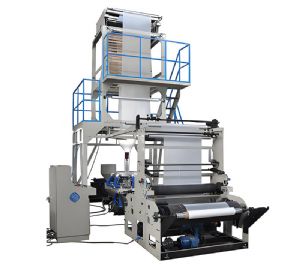
Blown Film Machine
Key considerations for each layer count: – Single: simplest, lowest cost, limited to blends. – 3-layer: basic functional separation (sealant/core/outer). – 5-layer: adds tie layers for barrier resins (EVOH/PA). – 7-layer: allows two barrier layers or multiple functional layers. – 9-layer: maximum flexibility for high-end applications (medical, retort). – Each additional layer requires an extruder, a melt pump, and a temperature zone. – The die cost increases non-linearly with layer count (more mandrels, heating zones). – Changeover time and complexity increase with layer count. – Operator training is more extensive for higher layer counts. – Interfacial instability risk increases with more layers, especially if viscosity mismatch exists. – Use of tie layers is mandatory for incompatible polymers (e.g., PE and EVOH). – Layer ratio accuracy is critical; individual extruder outputs must be controlled within ±1%. – Advanced AGC with NIR is needed for layer-specific thickness control. In practice, most converters start with 3-layer and upgrade to 5-layer as they gain experience and market demand. 7-layer and 9-layer lines are typically custom-engineered for specific products. The investment in a 9-layer line can be 3-4 times that of a single-layer line, but the margins are also significantly higher. In conclusion, the choice of layer count is a strategic business decision that must be aligned with market needs and technical capabilities. By carefully selecting the layer structure and ensuring proper rheological matching, converters can produce high-performance films that command premium prices.
