Advanced Lay-flat Control and Slitting/Rewinding Process for Finished Rolls 2026
After the film is collapsed by the collapsing frame and passed through the nip rolls, it emerges as a flattened tube – the "lay-flat" film. The lay-flat width is determined by the BUR and die diameter, and it must be consistent to produce rolls of the correct width. The collapsing frame's angle and nip roll alignment are critical for achieving a good lay-flat without wrinkles. The film should be flat and free of wrinkles before winding. The slitting/rewinding process converts the master roll into finished rolls of specific widths and lengths. The slitter-rewinder unwinds the master roll, slits it into multiple narrower strips using circular knives or razor blades, and rewinds each strip onto individual cores. The slitting station must be precise; any blade misalignment causes rough edges or dust. The rewinding section has separate tension controls for each slit strip to maintain uniform roll hardness. In summary, the lay-flat and slitting/rewinding process is the final step in transforming the blown film into a marketable product. The quality of the finished rolls depends on the accuracy of the lay-flat, the sharpness of the slitter blades, and the tension control during rewinding. The operator should inspect the rolls for telescoping, wrinkles, and edge quality. In conclusion, advanced lay-flat control and slitting/rewinding are essential for producing high-quality finished rolls that meet customer specifications.
The tension control during rewinding is critical to avoid telescoping (where the layers shift sideways) or blocking (where the film sticks to itself). The tension should be set based on the film thickness and material; thinner films require lower tension. A dancer roll or load cell provides feedback to the control system. The slitter blades should be sharpened regularly; dull blades cause ragged edges and dust. The slit width accuracy should be within ±0.5 mm. In practice, the operator should check the roll hardness (using a durometer) and adjust tension if needed. The lay-flat should be checked for any wrinkles; if present, adjust the collapsing frame or nip roll pressure. In conclusion, advanced lay-flat and slitting/rewinding process control ensures consistent roll quality, reducing waste and customer complaints.
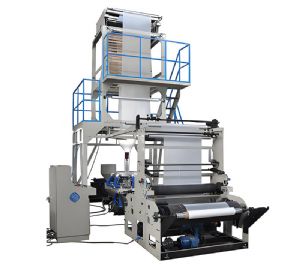
Blown Film Machine
Lay-flat control: Collapsing frame angle and alignment. Nip roll pressure and alignment. Wrinkle prevention: adjust frame and nip. Slitting/rewinding: Slitter blades: sharp, aligned. Tension control: based on thickness and material. Roll hardness: check with durometer. Edge quality: inspect for roughness. In practice, the operator should log roll quality data and adjust as needed. In conclusion, advanced lay-flat and slitting/rewinding are key to producing defect-free finished rolls.
