Advanced Lay-Flat Width Control and Its Impact on Bag Dimensions and Winding Quality 2026
Lay-flat width is the width of the collapsed film tube, measured after the nip rolls, and it is a critical dimension for downstream converting, especially for bag-making. For a given die diameter, the lay-flat width is determined by the blow-up ratio (BUR): Lay-flat = π × Die Diameter × BUR / 2. Therefore, controlling lay-flat width is equivalent to controlling BUR, which is achieved by adjusting the internal bubble pressure (or the haul-off speed). The lay-flat width must be maintained within tight tolerances (typically ±5 mm) to ensure that bags meet size specifications. Variations in lay-flat width cause bags that are too wide or too narrow, leading to customer complaints and scrap. The measurement of lay-flat width can be done manually (using a ruler) or automatically using an ultrasonic or optical sensor that measures the collapsed tube width. The automatic sensor provides real-time feedback to the control system, which adjusts the internal pressure to maintain the setpoint. The control loop must be stable; a fast response can cause oscillation, while a slow response allows width drift. The control algorithm often includes a deadband to prevent unnecessary adjustments. In summary, lay-flat width control is a key process variable for bag producers. It is achieved through precise internal pressure control and reliable width measurement. The use of an automatic lay-flat control system with a feedback loop significantly reduces operator intervention and improves consistency.
The lay-flat width also affects the winding quality. If the width varies, the tension across the roll will be uneven, leading to telescoping or edge wrinkling. Therefore, the winder's tension control must be coordinated with the
Lay-flat width control. In some lines, the lay-flat width is measured at the winder infeed, and the signal is used to adjust the internal pressure. The relationship between internal pressure and lay-flat width is non-linear; a small pressure change can cause a significant width change, especially at low BUR. Therefore, the control system must have accurate pressure regulation and a well-calibrated sensor. The use of a pressure transducer on the internal air supply provides feedback for the pressure control loop. In practice, the operator sets the target lay-flat width, and the automatic system adjusts the internal pressure. The system also compensates for changes in line speed; when speed increases, the bubble tends to narrow (due to neck-in), so the system increases internal pressure. In summary, lay-flat width control is a dynamic process that must respond to speed changes and other disturbances. A robust control system with good tuning is essential for maintaining consistent bag dimensions. In conclusion, lay-flat width is a critical parameter for tubular film lines. Its precise control ensures that bags meet specifications and that winding is defect-free, reducing waste and improving customer satisfaction.
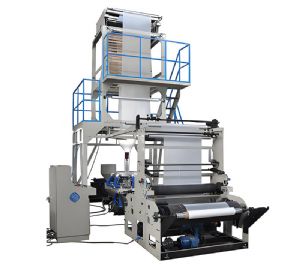
Blown Film Machine
Key measurement methods: – Manual: using a ruler or tape measure; simple but labor-intensive. – Ultrasonic sensor: non-contact, measures width between edges. – Optical sensor: line scan camera detects edges. – Laser triangulation: measures distance to edges. – Encoder on collapsing frame: indirect measurement. Control strategies: – PID control of internal pressure based on width error. – Cascade control: inner loop for pressure, outer loop for width. – Feedforward from line speed to anticipate width changes. – Deadband to avoid chattering. – Alarm for excessive deviation. Tuning: – Set proportional gain based on width response to pressure step. – Integral gain to eliminate steady-state error. – Derivative gain to dampen oscillation (optional). – Update rate: 1-2 seconds. In practice, the automatic lay-flat control system is a valuable addition to any tubular film line. It reduces operator workload and improves consistency, leading to better bag quality and less material waste.
