Advanced Lamination Film Blowing System: High-Clarity Film Production for Adhesive and Thermal Lamination 2026
A lamination film blowing system produces films that serve as the top layer in lamination processes – bonding to other substrates (paper, board, film) to provide protection, gloss, and barrier. These films are typically made from LDPE, PP, or PET (but PET is often cast; blown is for PP and PE), with thicknesses of 15-100 µm and high optical clarity (haze <5%, gloss >80%). The extrusion line must be optimized for surface quality; any gels, die lines, or contaminants will be visible in the final laminate. The extruder screw must have excellent homogenization to avoid gels; a barrier screw with a mixing section is used. The melt temperature is typically 190-230°C, and the die is a spiral mandrel type with a polished surface to minimize die lines. The cooling system must be very efficient and symmetric; chilled air and IBC are often used to achieve rapid, uniform cooling, which reduces haze. The line speed is moderate (80-150 m/min). The film is corona-treated to enhance adhesion for the subsequent lamination adhesive. The winder must produce rolls with very even tension to avoid blocking (sticking). In summary, the lamination film line is a high-quality, precision system that prioritizes surface perfection and optical clarity. The operator must maintain an extremely clean environment and monitor the film for any defects. Regular die cleaning and screen changes are essential to prevent gels.
The film's surface smoothness is critical; any roughness affects the lamination bond. The use of anti-block additives (e.g., silica) is often minimized to maintain clarity, but a small amount is needed to prevent blocking. Slip agents are also used. The film's shrinkage must be controlled; excessive shrink causes distortion in the laminate. The line's cooling and orientation (BUR, DDR) must be set to minimize shrink. The film's thickness uniformity is critical for uniform adhesive application; AGC is used. In practice, the lamination film line often runs with a dedicated clean area to prevent dust contamination. The operator must inspect the film under a light table for defects. The film's properties (haze, gloss, shrink) are tested regularly. In conclusion, the lamination film blowing system is a specialized line that produces high-quality films for lamination, requiring meticulous attention to cleanliness, optical properties, and dimensional stability.
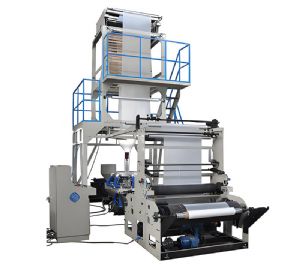
Blown Film Machine
Key film properties: – Haze: <5%. – Gloss: >80% (at 45°). – Thickness: 15-100 µm. – Shrinkage: <2% at lamination temperature. – Surface tension: >38 dyne/cm (after corona). – Coefficient of friction: controlled for handling. Process parameters: – Resin: LDPE, LLDPE, PP, or blends. – Melt temperature: 190-230°C. – BUR: 2.5-3.5. – Line speed: 80-150 m/min. – Cooling: chilled air + IBC for low haze. – Corona: inline for adhesion. Quality tests: – Haze and gloss (ASTM D1003, D523). – Shrinkage at lamination temperature. – Gel count (visual inspection). – Thickness gauge profile. – Adhesion (dyne level). Common issues: – Gels: improve filtration or change resin. – Die lines: clean die lip. – Haze: increase cooling or adjust BUR. – Blocking: adjust anti-block or winding tension. In practice, the lamination film line is often run with a high level of automation to maintain consistency. The operator must be trained to detect subtle surface defects. In conclusion, lamination film blowing is a demanding application that requires a clean, precise line to produce films that meet the high aesthetic and functional standards of the laminating industry.
