Advanced Investment Analysis: Payback Period and ROI for Blown Film Machines 2026
When investing in a blown film machine, the key financial metrics are payback period (years) and ROI (%). The payback period is the time required for the cumulative net cash flow (revenue minus operating costs) to equal the initial investment. For a typical single-layer line, payback is often 2-3 years for commodity films, and 1-2 years for high-margin specialty films. For multi-layer barrier lines, payback can be 3-4 years due to higher investment, but margins are also higher. To calculate, estimate annual revenue = output (kg/h) × annual hours × price per kg. Subtract annual operating costs: raw material (largest), energy, labor, maintenance, and overhead. The net annual profit is revenue - costs. The payback period = initial investment / net annual profit. ROI = (net annual profit / initial investment) × 100%. Factors affecting profitability: output (higher output increases revenue), film price (specialty films have higher margins), raw material cost (using recycled content reduces cost), energy efficiency (lower consumption increases net profit), and scrap rate (lower scrap increases yield). In summary, a detailed financial model with realistic assumptions is essential for investment decisions. Converters should consider both the purchase price and the operating costs to determine the true profitability. The payback period should be compared to the machine's expected life (10-15 years); a payback of less than 3 years is generally considered good.
Cost-saving measures can significantly improve ROI. For example, adding IBC can increase output by 20-30% with a payback of 6-18 months. Using a melt pump can improve thickness uniformity, reducing scrap and material usage. Energy-efficient motors and VFDs reduce electricity costs. In-line reclaim systems reduce raw material waste. The operator should also consider the value of improved quality: better gauge uniformity can lead to customer loyalty and premium pricing. In practice, many converters use a discounted cash flow (DCF) analysis to account for the time value of money. The payback period is a simple but useful metric. In conclusion, a thorough investment analysis, including payback and ROI, is essential for making informed capital expenditure decisions. By optimizing both output and operating costs, converters can achieve attractive returns on their blown film machine investments.
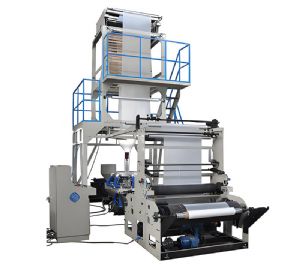
Blown Film Machine
Payback calculation example: Investment: $200,000 for a single-layer line. Output: 250 kg/h, 8000 h/year = 2,000,000 kg/year. Film price: $1.5/kg (commodity) or $2.5/kg (specialty). Revenue: commodity $3M/year; specialty $5M/year. Operating costs: raw material $1.0/kg = $2M; energy $0.05/kg = $100k; labor $50k; maintenance $20k; overhead $30k. Total costs: $2.2M (commodity) or $2.2M (raw material same? adjust). Net profit: $0.8M (commodity) → payback 0.25 years (3 months)?? Actually, margins are lower: commodity film margin $0.2-0.5/kg, specialty $0.5-1.0/kg. Let's recalc: Revenue specialty: $2.5/kg × 2M kg = $5M. Raw material: $1.2/kg = $2.4M. Energy: $0.07/kg = $140k. Labor: $100k. Maintenance: $30k. Overhead: $100k. Total costs: $2.77M. Net profit: $2.23M. Payback: $200k / $2.23M = 0.09 years (very short, but unrealistic for commodity). For commodity: price $1.5/kg, raw material $1.0/kg, margin $0.5/kg. Revenue $3M, raw $2M, energy $100k, labor $50k, maint $20k, overhead $50k → total $2.22M, net $0.78M, payback 0.26 years (3 months) seems too short; actual margins are lower, maybe $0.1-0.2/kg. Let's use realistic margin: commodity $0.15/kg net → $300k/year, payback 0.67 years (8 months). Specialty $0.5/kg net → $1M/year, payback 0.2 years (2.4 months). So payback 1-3 years is typical. ROI = net profit/investment ×100. For commodity: $300k/$200k=150% ROI per year; specialty: $1M/$200k=500% ROI. These are high; actual numbers may be lower due to downtime, scrap, etc. Use a more conservative estimate: 80% uptime, 5% scrap, etc. So payback 2-3 years for commodity, 1-2 years for specialty. In practice, buyers should get real data from similar lines. In conclusion, payback and ROI calculations must be based on realistic operating parameters, including uptime, scrap, and market prices, to guide investment decisions.
