Advanced Internal Bubble Cooling (IBC) Process: Heat Transfer Modeling and Control Optimization 2026
Internal Bubble Cooling (IBC) is a process enhancement that introduces chilled air into the interior of the blown film bubble, complementing the external air ring cooling. The IBC process involves a tube inserted through the die center that delivers cooled, conditioned air onto the inner surface of the molten film. This dual-sided cooling dramatically increases the heat transfer rate, allowing higher line speeds (20-40% increase) and better thickness uniformity because the cooling is more symmetrical and rapid. The IBC process is controlled by regulating the flow rate and temperature of the internal air. The flow rate determines the cooling intensity – more air lowers the frost line; less air raises it. The temperature of the internal air is typically set between 5°C and 15°C, achieved via a chiller. The internal air also creates a slight positive pressure inside the bubble, which helps stabilize the bubble and control lay-flat width. The IBC system includes a blower, a chiller, a distribution manifold (inside the bubble), a pressure sensor, and a control valve. The control algorithm maintains a constant frost line height by adjusting internal air flow in response to changes in line speed, output, or external temperature. In summary, the IBC process is a powerful tool for increasing productivity and quality. The operator must tune the IBC control loop to match the bubble's response time (typically 10-30 seconds). The internal air flow should be balanced with external cooling to avoid over-cooling or instability. In conclusion, advanced IBC process control is essential for maximizing the benefits of internal cooling, enabling higher output and better film quality.
The heat transfer modeling of IBC involves solving the energy balance for the film as it moves upward. The film's temperature profile along the height is determined by the heat removal from both sides. The model inputs include film thickness, line speed, melt temperature, air ring conditions, and IBC conditions. The model outputs the frost line height and the film's final temperature. The model can be used to predict the effect of changes in IBC flow on the frost line, aiding in control design. The model can also be used for offline optimization, finding the optimal IBC settings for a given product. In practice, the control system can use the model as a soft sensor to estimate the frost line when the camera is unavailable. In conclusion, advanced heat transfer modeling and control optimization are key to achieving consistent IBC performance, enabling higher speeds and better quality.
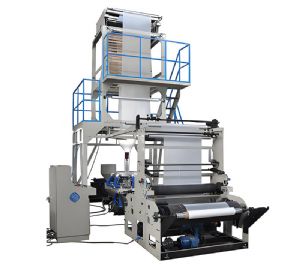
Blown Film Machine
Key IBC parameters: Internal air temperature: 5-15°C. Internal air flow: typically 10-30% of external flow. Internal pressure: 200-500 Pa. Dew point: below -10°C to prevent condensation. Frost line setpoint: based on product. Control algorithms: PID with feedforward from line speed. Model predictive control for multi-variable optimization. Tuning: gain and integration time based on bubble response. In practice, the operator should monitor the frost line and adjust IBC flow if needed. Regular maintenance of the IBC manifold and chiller is essential. In conclusion, advanced IBC process control is key to achieving high output and consistent quality.
