Advanced Internal Bubble Cooling: Heat Transfer Enhancement and Process Control 2026
Internal Bubble Cooling (IBC) is a technology that introduces chilled, conditioned air into the interior of the blown film bubble to enhance cooling from the inside. The principle is to increase the heat transfer surface area and provide additional cooling, thereby allowing higher line speeds or thicker films. The IBC system consists of a chiller to cool the air, a blower to deliver the air, a distribution manifold inside the bubble, a pressure control valve, and a control system. The cooled air (typically 5-15°C) is directed onto the inner surface of the molten film, removing heat. The heat transfer coefficient for internal air is lower than for the external air ring because the internal air velocity is lower, but the additional surface area compensates. The combined external and internal cooling can increase the total heat removal rate by 30-50%, enabling a similar increase in output. The IBC also improves thickness uniformity by providing symmetrical cooling, which reduces gauge bands. The internal air pressure is typically maintained at 200-500 Pa above atmospheric to stabilize the bubble; this pressure is controlled by a valve that regulates the exhaust. The internal air flow rate is adjusted to maintain the desired frost line height; higher flow lowers the frost line. The IBC control system must be coordinated with the external air ring to balance cooling. In summary, IBC is a powerful tool for increasing productivity and quality. Its effectiveness depends on the chiller capacity, the distribution manifold design, and the control algorithm. The chiller must be sized to handle the peak cooling load; a typical IBC system requires a chiller capacity of 10-30 kW, depending on the line output. The distribution manifold must spread the air evenly; any asymmetry causes thickness variations. The control system must maintain stable internal pressure to prevent bubble collapse. Regular maintenance of the chiller and the manifold is essential.
The control of IBC involves managing the internal air flow and temperature to achieve a stable frost line. The control algorithm is typically a cascade loop: the outer loop uses the frost line setpoint to adjust the internal air flow; the inner loop controls the internal air temperature using the chiller. The frost line is measured by a camera or a laser sensor. The internal air flow is adjusted by a butterfly valve or a VFD on the blower. The internal air temperature is maintained by the chiller; the chiller's setpoint is typically fixed, but some systems adjust it based on the cooling demand. The dew point of the internal air must be maintained below the film's surface temperature to prevent condensation, which would cause water spots and haze. This is achieved by using a desiccant dryer or a refrigeration dryer in the IBC air supply. The dew point is typically set to -10°C or lower. In summary, IBC control is a sophisticated multi-variable problem that requires precise sensors and actuators. Advanced systems use model predictive control to anticipate changes in line speed or output and adjust internal air proactively. The operator must monitor the internal pressure and the dew point; any alarm should be addressed immediately. In conclusion, IBC is a proven technology for boosting blown film production. By enhancing cooling and improving uniformity, it allows converters to achieve higher speeds and better quality, with a relatively quick payback on the investment.
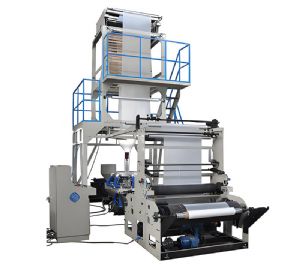
Blown Film Machine
Key IBC components: – Chiller: air-cooled or water-cooled, capacity based on heat load. – Blower: for internal air, with VFD. – Distribution manifold: inside the bubble, with multiple outlets. – Pressure transducer: for internal pressure. – Dew point sensor: to monitor moisture. – Temperature sensors: for internal air inlet and outlet. – Exhaust valve: to regulate pressure. – Controller: integrated with line PLC. Control parameters: – Internal air temperature: 5-15°C. – Internal air flow: typically 10-30% of external flow. – Internal pressure: 200-500 Pa. – Dew point: below -10°C. – Frost line setpoint: based on product. Maintenance: – Clean manifold regularly. – Check chiller refrigerant level. – Replace desiccant in dryer. – Calibrate pressure and temperature sensors. – Inspect ducting for leaks. In conclusion, IBC is a key technology for high-performance blown film lines. With proper design and maintenance, it provides significant productivity gains and quality improvements, making it a standard feature on modern high-output lines.
