Advanced Internal Bubble Cooling Film Extruder: Heat Transfer Modeling and IBC Control 2026
An internal bubble cooling (IBC) film extruder integrates an IBC system to enhance cooling and output. The heat transfer in IBC involves both external (air ring) and internal (IBC) convection. The total heat removal rate is the sum of the two; the internal air removes heat from the inner surface, reducing the temperature gradient across the film thickness and allowing faster line speeds. The heat transfer coefficient for internal air is lower than external because of lower velocity, but the internal surface area is similar. The combined effect can increase output by 20-40%. The IBC system's performance depends on the air temperature, flow rate, and distribution. The control system adjusts the IBC air flow based on the frost line height measured by a camera. The control algorithm is often a cascade: the outer loop sets the frost line setpoint, and the inner loop regulates the internal air flow via a valve or blower speed. The internal air temperature is maintained by a chiller, and its setpoint is typically fixed based on the product. The dew point of the internal air is controlled to prevent condensation, which would cause water spots on the film. A dew point sensor and a desiccant dryer are used. In summary, the IBC film extruder is a sophisticated system that requires precise control of air flow, temperature, and dew point. The heat transfer modeling helps in designing the system and tuning the control. The operator must monitor the frost line and adjust the IBC settings if the line speed or product changes. The investment in IBC is justified by the significant increase in output and improvement in gauge uniformity.
The heat transfer modeling of IBC involves solving the energy balance for the film as it moves upward. The film's temperature profile along the height is determined by the heat removal from both sides. The model inputs include film thickness, line speed, melt temperature, air ring conditions, and IBC conditions. The model outputs the frost line height and the film's final temperature. The model can be used to predict the effect of changes in IBC flow on the frost line, aiding in control design. The model can also be used for offline optimization, finding the optimal IBC settings for a given product. In practice, the model is often simplified to a one-dimensional energy balance; more complex CFD models are used for die and air ring design. The control system can use the model as a soft sensor to estimate the frost line when the camera is unavailable. In summary, heat transfer modeling is a powerful tool for IBC system design and optimization. It enables a better understanding of the process and helps in achieving consistent performance. In conclusion, the IBC film extruder is a high-performance system that leverages advanced heat transfer and control technologies to boost productivity and quality. Its successful operation depends on a thorough understanding of the cooling dynamics and precise control of the IBC parameters.
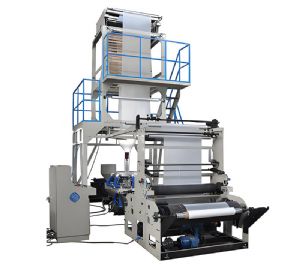
Blown Film Machine
Key IBC parameters: – Internal air temperature: 5-15°C. – Internal air flow: typically 10-30% of external flow. – Internal pressure: 200-500 Pa. – Dew point: below -10°C. – Frost line setpoint: based on product. Control algorithms: – PID control of internal air flow based on frost line error. – Cascade: outer loop (frost line) -> inner loop (flow). – Feedforward from line speed to anticipate flow changes. – Model predictive control for multi-variable optimization. Heat transfer modeling: – Energy balance: Q = h_ext × A_ext × ΔT_ext + h_int × A_int × ΔT_int. – h values from empirical correlations for impinging jets. – Boundary conditions: melt temperature at die, ambient temperature. – Output: frost line height, temperature profile. – Validation with measured data. In practice, the IBC system must be regularly maintained (clean manifold, check chiller, replace desiccant). The operator should monitor the dew point and internal pressure. In conclusion, the IBC film extruder is a key technology for high-output lines, enabling significant productivity gains through enhanced cooling.
