Advanced Industrial Liner Film Extrusion: Heavy-Gauge Film for Geomembrane and Construction Applications 2026
Industrial liner film extrusion produces thick, tough films used for pond liners, pit liners, tank covers, construction vapor barriers, and protective covers. These films are typically 100-300 microns thick, with lay-flat widths up to 6 meters, and are made from HDPE, LLDPE, or blends with high UV stability and puncture resistance. The extrusion line is a heavy-duty system with a large extruder (diameter 100-200 mm) and a high-torque gearbox to handle the high melt viscosity. The screw is a barrier type with a high compression ratio (3.5-4.5:1) and a bimetallic barrel for abrasion resistance. The die is large (400-800 mm) with a wide gap (1.5-3.0 mm) to accommodate the thick melt. The cooling system is robust: a high-capacity dual-lip air ring with IBC is essential to remove the substantial heat from the thick film. The line speed is low (10-30 m/min) to allow adequate cooling. The winder is a heavy-duty turret type capable of handling rolls weighing over 1000 kg. The film is often produced as a single-layer (e.g., HDPE) or 3-layer with a core containing recycled material and outer layers for UV protection. In summary, industrial liner extrusion is a high-torque, low-speed process designed for thick, wide films. The operator must monitor melt pressure and temperature closely; the high viscosity requires precise temperature control. The bubble stability is critical; the thick film has high sag, so a bubble cage and careful collapsing frame adjustment are needed. The film's properties (tensile, tear, puncture) are tested per ASTM standards.
The cooling of thick industrial liners is the primary challenge. The heat removal rate must be sufficient to solidify the film without causing haze or brittleness. The air ring delivers high-velocity air, often chilled, and IBC provides internal cooling. The frost line is set at 400-600 mm to allow adequate cooling time. The bubble stability is enhanced by using a lower BUR (2.5-3.0) to reduce circumferential stretch. The nip roll pressure must be high (4-6 bar) to grip the thick film. The winder tension must be controlled to avoid stretching. The film may be embossed or textured for slip resistance. The line often includes an edge trim recycling system; the trim is granulated and fed back to the extruder (usually to the core layer). In practice, the industrial liner line is often run with high recycled content in the core (up to 50%) to reduce cost, while the outer layers are virgin for quality. The operator must ensure the reclaim is clean and dry. In conclusion,
Industrial liner film extrusion is a demanding application that requires robust equipment and careful process control to produce thick, uniform films for critical containment and protection applications.
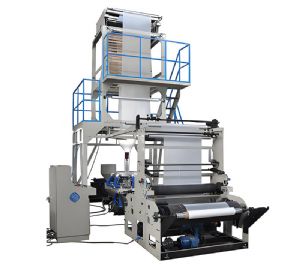
Blown Film Machine
Key process parameters: – Film thickness: 100-300 µm. – Lay-flat width: up to 6 m. – Output: 300-800 kg/h. – Line speed: 10-30 m/min. – Melt temperature: 200-240°C (for HDPE). – BUR: 2.5-3.0. – Frost line: 400-600 mm. – Cooling: air ring + IBC, chilled air optional. – Nip pressure: 4-6 bar. – Winder: heavy-duty turret. Material properties: – Tensile strength (MD): >25 MPa. – Tear resistance: high. – Puncture resistance: critical. – UV stability: with additives (2-5% HALS). – Density: 0.94-0.96 (HDPE) or 0.92-0.94 (LLDPE). Common issues: – Bubble instability: reduce BUR, increase cooling, use cage. – Gauge bands: check die temperature and air ring uniformity. – Sag: adjust collapsing frame and nip roll alignment. – Melt fracture: increase die gap or temperature. In practice, the line must be maintained meticulously; any downtime is costly. Regular screw pull-out for wear inspection is recommended. In conclusion, industrial liner film extrusion is a specialized, heavy-duty process that produces essential materials for civil engineering and environmental protection, demanding high reliability and quality.
