Advanced IBC Manifold Design and Air Distribution for Uniform Bubble Cooling 2026
The internal bubble cooling (IBC) manifold is a critical component that distributes the chilled air inside the bubble. The manifold is typically a tube with multiple outlets (nozzles or slots) that direct air onto the inner surface of the film. The design must ensure uniform air distribution around the circumference to avoid asymmetric cooling, which causes gauge bands. The manifold is suspended from the top of the tower and extends down into the bubble, positioned so that the outlets are at the frost line region. The air exits the manifold and impinges on the film, then travels upward and exits through the top of the bubble (or is recirculated). The manifold's geometry – the number of outlets, their diameter, and their orientation – determines the air distribution. CFD simulations are used to optimize the manifold design for a given bubble diameter and air flow. The pressure drop across the manifold must be balanced; if one outlet has a higher pressure, it will deliver more air, causing uneven cooling. Therefore, the manifold is often designed with a progressively increasing cross-section to maintain constant velocity. The manifold material is typically stainless steel or aluminum, and it must be smooth to prevent contamination. In summary, the manifold is a precision component that must be engineered for the specific line. Poor design leads to uneven cooling, which manifests as gauge bands and poor optical properties. Regular inspection and cleaning of the manifold are essential to prevent blockages. The operator should monitor the bubble shape; any asymmetry may indicate a manifold issue.
The air distribution from the manifold interacts with the external air ring; the combined cooling must be balanced to achieve a uniform frost line. The internal air flow is typically lower than the external flow, but it has a significant effect on the temperature gradient. The manifold's position (height) relative to the frost line is also critical; if it is too high, the air cools the already solidified film (wasted energy); if too low, it may disturb the melt flow. The optimal position is just below the frost line, where the film is still molten. The manifold's outlets are often angled to direct air tangentially to the film, promoting a swirling flow that enhances heat transfer and stability. Some designs use a perforated tube that provides a more diffused flow. The control system adjusts the internal air flow to maintain the frost line, but the manifold's design determines the uniformity of that flow. In summary, the manifold is a key enabler of effective IBC. Its design must be tailored to the bubble size and cooling requirements. By using CFD and careful prototyping, manufacturers can achieve the symmetric cooling needed for high-quality film. In conclusion, the IBC manifold, though often overlooked, is a critical component that directly affects film uniformity and stability. Investing in a well-designed manifold and maintaining it properly ensures that the benefits of IBC are fully realized.
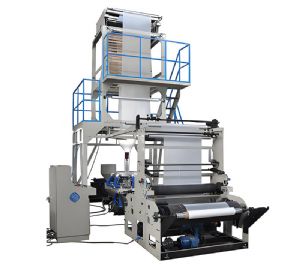
Blown Film Machine
Key design parameters: – Number of outlets: typically 4-8, depending on bubble size. – Outlet diameter: determines flow velocity and pressure drop. – Outlet angle: tangential for stability, perpendicular for cooling. – Manifold diameter: affects pressure drop and velocity profile. – Position relative to die: height adjustment. – Material: corrosion-resistant, smooth finish. – Cleaning access: for maintenance. CFD optimization: – Model the internal air flow and heat transfer. – Evaluate uniformity of velocity and temperature. – Iterate design to minimize asymmetry. – Validate with physical measurement (thermal imaging). Operational considerations: – Pressure drop across manifold should be monitored. – Any blockage causes uneven cooling; clean regularly. – Manifold should be centered; adjust if bubble drifts. – The internal air flow must be balanced with external cooling. – The dew point of internal air must be maintained. In conclusion, the IBC manifold is a precision device that requires careful design and maintenance. By ensuring uniform air distribution, converters can achieve the full benefits of IBC – higher output and better quality – without the penalty of gauge bands.
