Advanced High-Speed Automatic Blown Film Line: Dynamic Response and Fast Control Loops 2026
A high-speed automatic blown film line is designed to operate at speeds exceeding 150 m/min, often up to 300 m/min, for thin films (10-30 µm). The key challenge is maintaining bubble stability and thickness uniformity at these high speeds, which requires very fast control loops and precise automation. The extruder is equipped with a high-torque motor and a barrier screw optimized for high throughput. The cooling system is oversized, with a high-efficiency air ring (often dual-lip with chilled air) and IBC, to provide the rapid cooling needed. The bubble is stabilized by a combination of a bubble cage, internal pressure control, and an automatic frost line control system using a camera. The thickness gauge is a fast-scanning beta or X-ray type with a scan rate of >100 Hz, and the AGC system must respond within milliseconds to correct gauge variations. The die thermal bolts are often replaced by faster piezoelectric actuators for real-time profile correction. The winder is a fully automatic turret type with automatic roll transfer, core loading, and roll unloading, allowing continuous operation without stopping. The control system uses a high-speed PLC with a model predictive control (MPC) algorithm to coordinate all drives and cooling systems. In summary, the high-speed automatic line is a highly integrated system where every component must have fast response times. The automation reduces operator intervention and ensures consistent quality at high speeds. The investment is substantial, but the output and efficiency gains are significant for high-volume production.
The dynamic response of the control system is critical for high-speed operation. When the line speed changes (e.g., during acceleration or deceleration), the cooling, extruder output, and winder tension must adjust simultaneously to maintain film thickness and bubble stability. The MPC algorithm uses a process model to predict the effect of speed changes and pre-adjusts the cooling and extruder speed, reducing the thickness deviation. The AGC system must correct any gauge variation within a fraction of a second; piezoelectric actuators provide the fast response needed. The winder's automatic roll transfer takes 2-5 seconds, during which the line continues to run at full speed; the tension control must compensate for the transient to avoid telescoping. The edge trim recycling system must handle the high trim volume at speed. In practice, the line's control system is tuned for each product; the gain settings and feedforward coefficients are stored in recipes. The operator monitors the system's performance via HMI and intervenes only when alarms occur. In summary, the dynamic response and fast control loops are the hallmarks of a high-speed automatic line. They enable stable, high-quality production at speeds that would be impossible with manual control. In conclusion, the high-speed automatic blown film line represents the state of the art in blown film technology, delivering maximum productivity with minimal scrap, making it ideal for high-volume commodity film production.
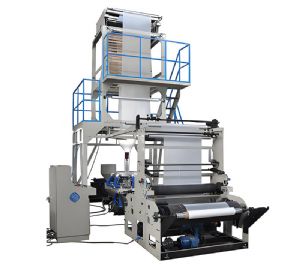
Blown Film Machine
Key high-speed components: – Extruder: high-torque motor, barrier screw, L/D 30-36:1. – Cooling: dual-lip air ring with chilled air, IBC. – Bubble control: camera-based frost line control, IBC pressure control. – Thickness gauge: fast-scanning (>100 Hz), beta or X-ray. – AGC: piezoelectric actuators for fast profile correction. – Winder: automatic turret with roll transfer <5 sec. – Control: PLC with MPC, fast I/O. Key dynamic parameters: – Acceleration/deceleration ramp rate: up to 5 m/min/s. – AGC correction time: <100 ms. – Winder transfer time: 2-5 sec. – Frost line response time: <1 sec. – Pressure control response: <0.5 sec. Typical products: – Thin films (10-30 µm) for bags, shrink wrap, stretch film. – Output: 200-600 kg/h. – Line speed: 150-300 m/min. In practice, the line is often run with minimal operator intervention, but regular maintenance of the sensors and actuators is essential. The control system must be backed up to prevent data loss. In conclusion, the high-speed automatic line is the pinnacle of blown film productivity, enabling converters to meet high-volume demands with consistent quality.
