Advanced Heavy-Duty Film Blowing Machine: High-Torque Extrusion and Thick Bubble Cooling 2026
A heavy-duty (HD) film blowing machine is engineered for producing thick, high-strength films typically ranging from 80 to 300 microns, with lay-flat widths up to 4 meters and outputs exceeding 500 kg/h. The extruder is the core component, featuring a large screw diameter (120-200 mm) with a high L/D ratio (30-36:1) and a barrier design optimized for high-viscosity melts. The gearbox must deliver high torque at low screw speeds (40-80 RPM) to process resins like HDPE, LLDPE, and blends with high filler content. The barrel is constructed from bimetallic material with a tungsten carbide liner to resist abrasion from fillers and recycled content. The heating system uses high-watt-density band heaters, and the cooling is typically water-jacketed for rapid temperature control. The die is large (400-800 mm), often of the spiral mandrel type, with multiple heating zones to maintain uniform temperature across the circumference. The die gap is wider (1.5-3.0 mm) to accommodate the thick melt. The air ring is a high-capacity dual-lip design, often supplemented by IBC to handle the substantial heat load. The collapsing frame and nip rolls are oversized to handle the heavy film without deformation. In summary, the HD machine is a robust system designed for continuous, high-output production of industrial films. Its components are oversized and reinforced to withstand the high pressures and temperatures associated with thick film extrusion. The operator must monitor the melt pressure and temperature closely to prevent degradation. The line speed is low (10-30 m/min), but the output is high due to the large extruder and die.
The cooling of thick bubbles is the primary challenge in HD film production. The heat removal rate must be sufficient to solidify the film before it reaches the nip, but not so fast as to cause haze or brittleness. The air ring provides the main cooling, with high-velocity air (30-50 m/s) and often chilled air (5-10°C). IBC is almost mandatory for HD lines, delivering cooled air inside the bubble to enhance cooling and improve gauge uniformity. The frost line height is typically set at 400-600 mm to allow adequate cooling time. The bubble stability is critical; the thick film has high sag, so the collapsing frame must be adjusted to support the bubble. A bubble cage is often used to prevent oscillation. The nip roll pressure must be high (4-6 bar) to grip the thick film without slipping. The winder is a heavy-duty turret type, capable of handling rolls weighing over 1000 kg. In summary, the cooling system of an HD line is a complex interplay of external and internal cooling, requiring precise control to achieve uniform solidification. The operator must adjust the cooling air flow, IBC flow, and line speed to maintain a stable frost line. Any imbalance causes gauge bands or bubble breakage. In conclusion, the HD film blowing machine is a specialized, high-capacity system that demands robust engineering and skilled operation. Its ability to produce thick, strong films makes it essential for heavy-duty packaging, construction, and agricultural applications.
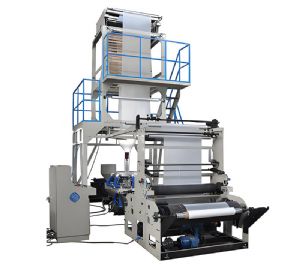
Blown Film Machine
Key HD line components: – Extruder: large diameter (120-200 mm), high-torque gearbox, bimetallic barrel. – Screw: barrier type, compression ratio 3.5-4.5:1, L/D 30-36:1. – Die: large diameter (400-800 mm), wide gap (1.5-3.0 mm). – Cooling: dual-lip air ring with chilled air, IBC. – Haul-off: heavy-duty nip rolls with high pressure (4-6 bar). – Winder: turret type, heavy-duty, automatic roll transfer. Key process parameters: – Output: 300-1000 kg/h. – Film thickness: 80-300 µm. – Line speed: 10-30 m/min. – Melt temperature: 200-240°C. – BUR: 2.5-3.5. – Frost line height: 400-600 mm. Common issues: – Bubble instability: increase cooling or reduce line speed. – Gauge bands: check die temperature uniformity and air ring symmetry. – Thick film sag: adjust collapsing frame and bubble cage. – Melt temperature rise: increase barrel cooling or reduce screw speed. In practice, the HD line is often run 24/7 to amortize the high capital cost. Preventive maintenance of the gearbox, bearings, and cooling system is essential to avoid unplanned downtime. In conclusion, the heavy-duty film blowing machine is a workhorse for industrial film production, delivering high output and robust film quality when properly operated and maintained.
