Advanced Haul-off Speed and Nip Roll Pressure Optimization for Film Tension and Flatness Control 2026
The haul-off unit, consisting of a pair of nip rollers (rubber and chrome), is responsible for pulling the collapsed film from the bubble at a controlled speed and applying the necessary pressure to grip the film without slipping. The haul-off speed (line speed) directly sets the film thickness for a given extruder output, while the nip roll pressure ensures positive traction. The pressure is typically applied by pneumatic cylinders, with a range of 2-6 bar depending on film thickness and stiffness. Insufficient pressure causes the film to slip, leading to speed fluctuations and thickness variations; excessive pressure can crush the film, causing stress marks, blocking, or even film breakage. The optimal pressure is determined by the film's coefficient of friction and the required traction force. For thin films (15-30 µm), a lower pressure (2-3 bar) is sufficient; for thick films (100-300 µm), higher pressure (4-6 bar) is needed. The pressure should be evenly distributed across the nip width; any unevenness causes the film to track sideways or develop wrinkles. In summary, haul-off speed and nip roll pressure are interdependent: the speed sets the thickness, and the pressure ensures the speed is accurately transmitted to the film. The operator should adjust the pressure based on the film thickness and material, and check for even distribution using a pressure-sensitive paper. The nip roll's rubber cover should be in good condition; wear or contamination affects grip.
The interaction between haul-off speed and nip roll pressure is critical during speed changes. When accelerating, the required traction force increases; if the pressure is insufficient, the film may slip, causing a temporary thickness increase. Therefore, the pressure should be set with a safety margin. The nip rolls must be parallel; misalignment causes uneven pressure and wrinkles. The nip roll gap (the separation when open) should be adjusted to allow easy threading. The haul-off speed is controlled by a servo motor with encoder feedback; the speed setpoint is compared to the actual speed, and the drive adjusts the motor torque. The nip roll pressure control can be manual (via regulator) or automatic (using a pressure transducer and PLC). In modern lines, the pressure is often set automatically based on the film thickness and speed, using a lookup table. In practice, the operator should check the film for any signs of slippage (e.g., marks or thickness variations) and adjust the pressure accordingly. Regular maintenance of the nip rolls (cleaning, checking bearings, and rubber condition) is essential. In conclusion, precise control of haul-off speed and nip roll pressure is essential for consistent film thickness, flatness, and winding quality. The operator must balance the pressure to provide adequate traction without damaging the film, and ensure the speed is accurately maintained.
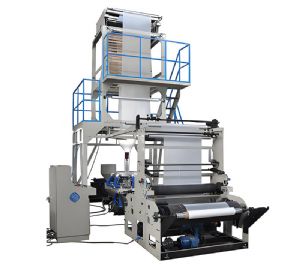
Blown Film Machine
Key parameters for nip roll pressure: Pressure range: 2-3 bar for thin films; 4-6 bar for thick films. Pressure distribution: must be uniform across width; check with pressure-sensitive paper. Nip roll condition: rubber cover should be smooth and free of debris. Parallelism: rolls must be parallel; misalignment causes wrinkles. Pressure control: manual or automatic (via PLC). Speed control: encoder feedback with PID. Film slippage detection: check for thickness variation or marks. In practice, the operator should also check the nip roll temperature; cooling the rolls can help set the film and reduce blocking. In conclusion, haul-off and nip roll pressure optimization is a key skill for blown film operators, ensuring consistent film quality and winding performance.
