Advanced Haul-off Speed Control and Its Interaction with Thickness and Orientation 2026
The haul-off speed (line speed) is the rate at which the film is pulled from the bubble by the nip rollers. It is the primary means of adjusting film thickness for a given extruder output: thickness is inversely proportional to haul-off speed. The relationship is given by: Thickness (µm) = Output (kg/h) × 1000 / (Line Speed (m/min) × Width (m) × Density (kg/m³) × 60). Therefore, to increase thickness, the haul-off speed must be decreased, and vice versa. However, changing the haul-off speed also affects the MD orientation, because the draw-down ratio (DDR) is the ratio of haul-off speed to the melt exit speed at the die. A higher haul-off speed increases DDR, which stretches the polymer chains in the MD, increasing tensile strength and stiffness but decreasing tear resistance and impact strength. Therefore, the haul-off speed must be set to achieve the desired balance of thickness and MD properties. The haul-off speed is controlled by the nip roll drive, which is typically a servo motor with a VFD. The speed setpoint is entered on the HMI, and the drive maintains it via encoder feedback. The haul-off speed is synchronized with the extruder speed and the winder speed. In summary, haul-off speed is a critical control parameter that directly affects thickness and MD properties. Its selection involves a trade-off between productivity and film characteristics. Operators must adjust it based on product specifications and monitor the resulting film properties.
The control of haul-off speed must be coordinated with the cooling system. Increasing the haul-off speed (to reduce thickness) also reduces the residence time of the film in the cooling zone, so the frost line rises unless cooling is increased. Therefore, when changing speed, the cooling air flow must be adjusted to maintain the frost line height. The control system often includes a master speed setpoint that scales all drives (extruder, haul-off, winder) proportionally, while the cooling system automatically adjusts based on the frost line feedback. This allows the operator to change the overall output (kg/h) by changing the master speed, while maintaining the thickness and properties. In practice, the
Haul-off speed is set during product changeover, and then the cooling is fine-tuned. The haul-off speed also affects the tension on the film; higher speed increases tension, which can cause neck-in. Therefore, the nip roll pressure may need adjustment. In summary, haul-off speed control is not isolated; it interacts with cooling, tension, and orientation. A coordinated approach is necessary to achieve stable operation. In conclusion, haul-off speed is a fundamental parameter that must be carefully managed to produce film with the correct thickness and properties. Its optimization requires a holistic view of the entire line, with adjustments to cooling and tension as needed.
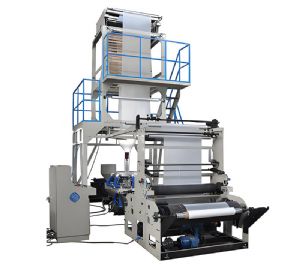
Blown Film Machine
Key relationships: – Thickness ∝ 1 / Haul-off speed (at constant output). – MD stretch (DDR) = Haul-off speed / Melt exit speed. – Higher speed → thinner film, higher MD tensile, lower tear. – Lower speed → thicker film, lower MD tensile, higher tear. – Frost line height increases with speed (if cooling unchanged). – Tension increases with speed (may cause neck-in). Control strategies: – Use master speed setpoint for coordinated changes. – Adjust cooling air flow with speed changes. – Monitor thickness gauge and adjust speed accordingly. – For product changeover, calculate new speed from thickness ratio. – Use ramp functions to avoid sudden changes. – Ensure winder speed matches haul-off speed. In practice, the haul-off speed is often the most frequently adjusted parameter by operators, as it is the direct lever for thickness control. Training in the effects of speed on properties is essential. In conclusion, haul-off speed control is a core skill for blown film operators, requiring a deep understanding of its impact on both thickness and film characteristics.
