Advanced HDPE Blown Film Machine: Processing High-Crystallinity Resins for Stiff Films 2026
HDPE (high-density polyethylene) is a highly crystalline polymer with a melting point of 130-135°C and a density of 0.94-0.96 g/cm³. It produces stiff, strong films with good moisture barrier, but it is more difficult to process than LDPE or LLDPE because of its narrow processing window and high melt elasticity. An HDPE blown film machine must be designed to handle these challenges. The screw is typically a barrier type with a high compression ratio (3.5-4.0:1) to ensure complete melting of the highly crystalline material. The barrel temperature profile is set higher than for PE: feed zone 170-180°C, compression 190-210°C, metering 200-220°C. The die temperature is also higher, around 200-220°C. The bubble is more sensitive to cooling; a lower BUR (2.0-2.5) is used to maintain stability because high BUR causes excessive TD orientation and instability. The cooling must be rapid to freeze the film and minimize haze; a dual-lip air ring with high airflow is used, and IBC is often added to enhance cooling. The line speed is typically high (150-250 m/min) because HDPE films are usually thin (10-30 µm) for bags and liners. In summary, the HDPE blown film machine is a specialized line that requires precise temperature control, a high-compression screw, and efficient cooling to produce high-quality, stiff films. The machine is optimized for the specific rheology of HDPE, ensuring stable bubble formation and consistent thickness.
The crystallization behavior of HDPE affects the film's optical and mechanical properties. Rapid cooling results in small crystallites, which improve clarity and gloss, but may increase stiffness. Slower cooling allows larger crystallites, reducing clarity. Therefore, the cooling rate must be optimized for the desired properties. The frost line height is typically low (300-400 mm) to ensure rapid solidification. The BUR is kept low to avoid excessive TD orientation, which reduces tear strength. The draw ratio (DDR) is moderate to balance MD and TD properties. The film's tear strength in the TD is inherently low for HDPE, which is why LLDPE is often blended (up to 30%) to improve tear resistance. The machine must be able to process such blends. The screw design must accommodate the blend's viscosity. In practice, HDPE lines are used for T-shirt bags, grocery sacks, and liners. The operator must monitor the bubble stability closely; any oscillation can cause gauge bands. The use of a bubble cage is recommended. The winder must handle the stiff film; surface winding is preferred to avoid telescoping. In summary, the HDPE blown film line is a high-speed, high-output system that requires careful optimization of cooling, BUR, and screw design. With proper settings, it can produce thin, stiff films with excellent moisture barrier for cost-sensitive applications. In conclusion, the
HDPE blown film machine is a workhorse for the bag industry, providing efficient production of lightweight, strong bags. Its operation demands a good understanding of the material's crystallization and rheology to achieve stable production and desired film properties.
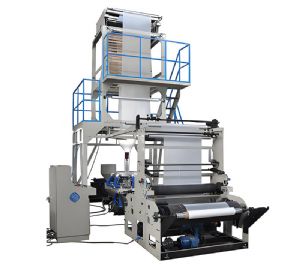
Blown Film Machine
Key HDPE processing parameters: – Melt temperature: 200-230°C; higher than LDPE. – BUR: 2.0-2.5; lower to maintain stability. – Frost line height: 300-400 mm; rapid cooling. – Line speed: 150-250 m/min for thin gauges. – Screw compression ratio: 3.5-4.0:1. – Die gap: 0.8-1.2 mm. – Cooling: high airflow, often with IBC. – Film thickness: 10-30 µm. Common issues: – Bubble instability: lower BUR or increase cooling. – High haze: increase cooling rate or use a nucleating agent. – Low tear strength: blend with LLDPE (10-30%). – Gauge bands: check air ring uniformity and die temperature. – Screw wear: HDPE is abrasive; use bimetallic barrel. In practice, the HDPE line is often run with blends to improve properties. The operator must adjust the temperature profile when changing blend ratios. Regular maintenance of the die and air ring is essential to prevent defects. In conclusion, the HDPE blown film machine is a specialized but essential asset for high-volume bag production, offering a cost-effective solution for lightweight packaging.
