Advanced Greenhouse Film Blowing Equipment: Multi-Layer UV Stabilized Films for Long Life 2026
Greenhouse film blowing equipment is specialized for producing thick (80-200 µm), wide (up to 16 m lay-flat) films with a service life of 3-5 years. These films must withstand intense UV radiation, temperature variations, and mechanical stress. The equipment is typically a 3-layer or 5-layer co-extrusion line, allowing different functional layers: an outer layer with high UV absorbers and dust resistance, a core layer with thermal retention additives (infrared absorbers), and an inner layer with anti-drip (anti-fog) surfactants to prevent condensation. The extruders are sized for high output (300-600 kg/h), and the die is large (600-800 mm). The cooling system is heavy-duty, with a high-capacity air ring and IBC to handle the thick film. The line speed is moderate (30-60 m/min). The UV stabilizers (HALS and UV absorbers) are compounded into the outer layer at high concentrations (2-5%). The anti-drip agents are surfactants that migrate to the surface to reduce water tension. In summary, the greenhouse film line is a high-investment system that produces films with long outdoor life. The layer structure and additive packages are critical for performance. The operator must monitor the additive feed rates and ensure uniform distribution. The film's properties (UV transmission, haze, light diffusion) are tested regularly.
The light diffusion properties of greenhouse films are important for uniform light distribution and preventing shadowing. The diffusion is achieved by adding light diffusing agents (e.g., calcium carbonate or silica) to the core layer. The haze level is typically 20-40%. The thermal retention is achieved by adding infrared absorbers (e.g., metal oxides) that trap heat inside the greenhouse. The anti-drip layer prevents water droplets from forming on the film, which can reduce light transmission and cause disease. The equipment must be able to process these abrasive additives; the screw and barrel should be wear-resistant. The die must distribute the layers uniformly; the outer layer with UV absorbers must be continuous without gaps. In practice, the greenhouse film line is often dedicated to a few product types. The operator must adjust the process parameters based on the additive load. In conclusion,
Greenhouse film blowing equipment is a specialized, high-value line that produces films essential for modern protected agriculture, enabling extended growing seasons and improved crop yields.
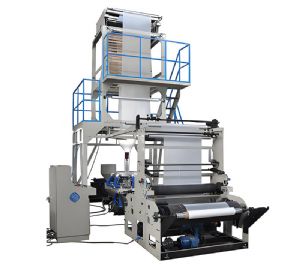
Blown Film Machine
Key layer structures: – 3-layer: outer (UV)/core (thermal)/inner (anti-drip). – 5-layer: outer/tie/core/tie/inner for enhanced adhesion. – Materials: LDPE, LLDPE, EVA (for thermal). – Additives: UV stabilizers (HALS, benzophenones), infrared absorbers, anti-drip surfactants, light diffusers. Process parameters: – Output: 300-600 kg/h. – Thickness: 80-200 µm. – Line speed: 30-60 m/min. – BUR: 2.5-3.5. – Melt temperature: 190-220°C. – Die temperature: uniform within ±1°C. Quality testing: – UV transmission (after accelerated weathering). – Haze and light diffusion. – Anti-drip performance (condensation test). – Tensile and tear strength. – Service life prediction (accelerated aging). In practice, the greenhouse film line is often run with high recycled content in the core layer to reduce cost, but the outer layers must be virgin for UV stability. The operator must ensure the additives are properly mixed and fed. In conclusion, greenhouse film blowing equipment is a technologically advanced system that produces high-performance agricultural films, requiring precise control of additives and layer structures.
