Advanced Gravimetric Feeding and Blending Ratio Control for Multi-Layer Co-extrusion 2026
The accuracy of screw feeding and blending ratio control directly determines the consistency of film thickness, mechanical properties, and, in multi-layer lines, the functionality of each layer. The feeding system supplies raw material – virgin resin, masterbatch, reclaim, and additives – to the extruder screw at a controlled rate. In modern lines, gravimetric (weight-based) feeders are standard, replacing volumetric feeders because they compensate for bulk density variations and provide superior accuracy (±0.5% or better). A typical system includes several feeders for different components, all synchronized with the extruder screw speed. The total feed rate sets the extruder output (kg/h), which must match the line speed and die gap to achieve the target film thickness. For multi-layer lines, each extruder has its own feeding system, and the ratio of the feeders' outputs determines the layer thickness percentages. For example, in a 3-layer film with 20/60/20 distribution, the feeders for the two outer layers must each supply 20% of the total mass, while the core layer supplies 60%. These ratios must be maintained precisely; even a 2% drift can significantly alter film properties (e.g., seal strength or barrier). The control system uses a master setpoint (total output) and calculates individual feeder speeds based on the stored recipe ratios. Feeders are typically loss-in-weight type, where the weight loss over time is measured and the screw speed adjusted to maintain the target feed rate. This closed-loop control ensures stable output even with varying bulk density. In summary, the feeding and blending system is the foundation of consistent extrusion. The operator must calibrate feeders regularly and monitor the feed rates. Any deviation in the blend ratio affects film properties, so the control system should have alarms for low or high rate deviations. In conclusion, advanced gravimetric feeding and blending ratio control are essential for producing consistent, high-quality multi-layer films, enabling precise layer thickness control and material efficiency.
The blending ratio control in multi-layer lines must account for the different melt densities and viscosities of the various resins. The gravimetric feeders measure mass flow, but the extruders deliver volumetric flow; the control system must convert mass flow to screw speed based on the melt density. The feeders should be calibrated with the actual resin to ensure accuracy. The layer ratio is often verified by NIR gauging (if available) or by collecting and weighing the melt from each extruder. In practice, the operator should monitor the layer ratio trends and adjust the feeder setpoints if needed. The reclaim feed rate is particularly variable; the reclaim feeder must be able to handle flake with different bulk density. A surge bin upstream of the reclaim feeder can smooth out fluctuations. The use of a central blending system with a master controller that coordinates all feeders is recommended for complex multi-layer lines. In conclusion, advanced screw feeding and blending ratio control are key to achieving consistent layer distribution and film properties, reducing scrap and material waste.
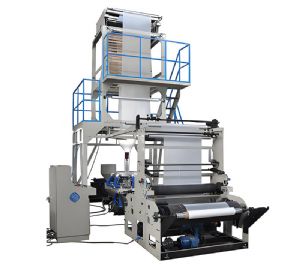
Blown Film Machine
Key components and parameters: Gravimetric feeders: loss-in-weight type, accuracy ±0.5%. Feeder calibration: use actual resin to set screw speed vs. mass flow. Blend ratio: controlled by master setpoint and recipe. Reclaim handling: surge bin for smooth feed. Control: closed-loop with alarms for deviation. Verification: NIR gauging or manual sampling. Maintenance: Regular calibration of load cells. Clean feeders to prevent buildup. Check for bridging or rat-holing. In practice, the operator should keep a log of feeder calibration values and blend ratios. If the film properties drift, the blend ratio should be checked first. In conclusion, advanced screw feeding and blending ratio control are essential for producing consistent, high-quality films.
