Advanced Gearbox and Bearing Preventive Maintenance: Vibration Analysis and Oil Condition Monitoring for Blown Film Extruders 2026
The gearbox and bearings are among the most critical mechanical components in a blown film extruder, transmitting high torque from the motor to the screw while withstanding axial and radial loads. Preventive maintenance is essential to avoid catastrophic failures that lead to extended downtime and costly repairs. The primary failure modes are gear tooth wear (pitting, scuffing), bearing fatigue (spalling, brinelling), and lubrication degradation. The most effective preventive strategy is condition-based maintenance using vibration analysis and oil analysis, rather than fixed time-based intervals. Vibration analysis involves mounting accelerometers on the gearbox housing to measure vibration velocity (mm/s) and acceleration (g). An increase in vibration at the gear mesh frequency (number of teeth × shaft speed) indicates gear wear; an increase at bearing defect frequencies (ball pass frequency, outer race frequency) indicates bearing damage. Baseline measurements are taken when the machine is new or after overhaul, and trends are monitored. ISO 10816-3 provides alarm limits for vibration velocity; for extruder gearboxes, values above 4.5 mm/s RMS typically trigger inspection. Oil analysis measures particle count (ISO 4406), viscosity, acid number (TAN), and water content. A sudden rise in particle count indicates wear debris; an increase in TAN suggests oil oxidation; water content above 0.1% causes corrosion. The oil should be sampled every 500-1000 operating hours, and the results are compared to alert limits. In summary, vibration and oil analysis provide early warning of component wear, enabling scheduled repairs before failure. The maintenance team should establish a monitoring schedule, record data, and take corrective actions when alarm levels are exceeded. This approach reduces unplanned downtime by up to 70% and extends component life by 20-30%.
In addition to condition monitoring, routine preventive tasks must be performed. Daily: check oil level and temperature; listen for abnormal noise. Weekly: inspect seals for leaks; check oil filter pressure drop. Monthly: take an oil sample for analysis; check coupling alignment. Quarterly: inspect breather vents; clean oil cooler fins. Annually: drain and replace oil (if analysis shows degradation); replace oil filter; inspect gears and bearings visually (partial disassembly). The gearbox oil should be a high-quality synthetic gear oil (ISO VG 320 or 460) with anti-wear and extreme pressure additives. The oil change interval can be extended if oil analysis shows it is still in good condition; this is a cost-saving benefit of condition monitoring. For bearings, the thrust bearing (which absorbs axial force from the screw) is the most critical. Its temperature should be monitored; a rise of 10°C above baseline indicates lubrication or alignment issues. The radial bearings should be checked for play using a dial indicator. In practice, the maintenance team should maintain a logbook with all readings and actions. Training operators to recognize early signs (temperature spikes, unusual noise) is essential. In summary, a combination of condition monitoring and scheduled tasks ensures gearbox and bearing reliability. The investment in monitoring equipment (vibration sensors, oil analysis kits) is quickly recovered by avoiding unplanned downtime. In conclusion, advanced preventive maintenance for gearboxes and bearings is a cornerstone of reliable blown film production, enabling high uptime and consistent operation.
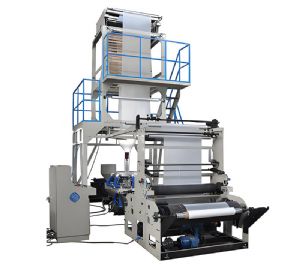
Blown Film Machine
Key vibration analysis parameters: Measurement points: gearbox input, output, and bearing housings. Frequency range: 0-1000 Hz for gear mesh, 0-200 Hz for shaft rotation. Alarm levels: velocity RMS >4.5 mm/s (ISO 10816-3). Bearing defect frequencies: BPFO (ball pass frequency outer), BPFI (inner), BSF (ball spin), FTF (fundamental train). Key oil analysis parameters: Particle count: ISO 4406, target <18/16/13. Viscosity: change >10% from new oil indicates degradation. TAN: increase >0.5 mg KOH/g indicates oxidation. Water content: <0.05% (preferred), <0.1% maximum. Additive depletion: monitor via FTIR. Maintenance schedule: Daily: oil level, temperature, noise. Weekly: seal inspection, filter pressure. Monthly: oil sample, coupling alignment. Quarterly: breather, cooler fins. Annually: oil change, filter replacement, visual inspection. Spare parts: Keep spare bearings (thrust and radial), seals, oil filters, and breathers. In practice, the maintenance team should calibrate vibration sensors annually. Oil analysis labs should be accredited (e.g., ISO 17025). In conclusion, gearbox and bearing preventive maintenance is a data-driven process that, when executed diligently, maximizes extruder reliability and minimizes production interruptions.
