Advanced Gauge Tolerance and Automatic Control for Minimizing Film Thickness Variation 2026
Gauge tolerance, defined as the allowable deviation from the target film thickness, is a key quality metric that directly affects material usage and converting performance. Tighter tolerance reduces material waste and improves consistency in printing and sealing. The primary tool for achieving tight tolerance is Automatic Gauge Control (AGC), which uses a scanning thickness gauge (beta, X-ray, or NIR) to measure the thickness profile across the film width. The gauge scan provides a profile of thickness versus position. The AGC system compares the profile to the target and calculates corrections for individual die bolts (thermal or piezoelectric). The correction is applied by heating or cooling the bolts, which changes the die gap locally. The control algorithm must be tuned to correct errors without causing overshoot or oscillation. The scan speed and the response time of the bolts determine the control bandwidth; faster scanning and faster bolts allow correction of higher-frequency variations. The gauge's accuracy and repeatability are also critical; regular calibration with known thickness standards is essential. The AGC can also control the average thickness by adjusting the haul-off speed, but the primary function is profile control. In summary, AGC is a closed-loop system that actively reduces thickness variation. It is the most effective method for achieving tight gauge tolerance. The performance of AGC depends on the gauge's quality, the die's bolt system, and the tuning of the control algorithm. Regular maintenance of the gauge (cleaning the window, calibrating) and the bolts (checking heaters) is essential.
The optimization of gauge tolerance involves not only the AGC but also the process stability. Variation can be caused by cooling non-uniformity, melt temperature fluctuations, or screw surging. Therefore, before tuning AGC, the process must be stabilized. The AGC tuning involves setting the gain (how aggressively the system corrects), the deadband (the error tolerance below which no correction is made), and the integration time (how long the system averages the error). Too high gain causes oscillation; too low gain results in slow correction. The deadband prevents unnecessary adjustments for small variations that are within acceptable limits. The integration time should be set based on the scan speed; a typical value is 2-4 scans. The AGC also includes a "profile shift" feature to compensate for any drift in the gauge's centering. In practice, operators monitor the AGC performance; if the profile has persistent high or low spots, it may indicate a stuck bolt or a die issue. Manual intervention may be needed to clean the die or adjust cooling. In summary, optimizing gauge tolerance requires a combination of stable process conditions, well-tuned AGC, and regular maintenance. The use of statistical process control (SPC) charts helps track the thickness variation over time, allowing early detection of drift. In conclusion, achieving tight gauge tolerance is a primary goal for blown film converters. By implementing AGC and maintaining the process, they can reduce material usage, improve quality, and enhance customer satisfaction.
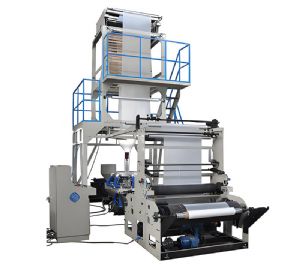
Blown Film Machine
Key AGC parameters: – Gain (proportional): determines correction magnitude. – Deadband: set to ±1-2% of target thickness. – Integration time: number of scans to average error. – Derivative (if used): to dampen overshoot. – Bolt heater power: must be calibrated. – Scan speed: faster scans allow quicker correction. – Update rate: how often corrections are sent to bolts. Tuning procedure: – Start with conservative gain (low) and no deadband. – Increase gain until oscillation appears, then reduce by 30%. – Add deadband to reduce unnecessary corrections. – Set integration time to 2-4 scans. – Verify profile improvement; adjust if needed. – For multi-layer films, use NIR layer-specific AGC. Maintenance: – Clean gauge window daily. – Calibrate gauge weekly with standard. – Check bolt heater resistance monthly. – Inspect die lip for damage. – Verify bolt movement with dial indicator. In conclusion, AGC is the cornerstone of gauge control. With proper tuning and maintenance, it can reduce thickness variation to ±2-3%, saving material and improving film quality.
