Advanced Garbage Bag Production Line: High-Speed Extrusion and In-Line Bag Making Integration 2026
A garbage / trash bag production line is an integrated system that combines a blown film extruder with downstream bag-making equipment to produce finished bags in one continuous process. The line starts with a single-layer or 3-layer blown film extruder producing a tubular film, typically 10-60 microns thick, from LDPE, LLDPE, or blends with recycled content. The extruder is optimized for high speed (150-200 m/min) and high output (200-500 kg/h). The screw is a barrier type with a high compression ratio, and the barrel is bimetallic for wear resistance. The die is circular, and the bubble is cooled by a high-efficiency air ring, often with IBC to boost output. The film is collapsed, passed through a thickness gauge (with optional AGC), and then fed directly into a bag-making machine that includes a folding board, heat seal bars, a perforating/cutting unit, and a stacker or winder. The bag machine creates the bottom seal, perforates the film, and cuts individual bags. The line can produce flat bags, gusseted bags, and T-shirt bags (with die-cut handles). The synchronization between the extruder and the bag machine is critical; any speed mismatch causes tension variations or bag length errors. In summary, the integrated production line eliminates intermediate roll handling, reducing labor and waste. The control system must coordinate the extruder speed, haul-off, and bag machine cycle. The operator must monitor the seal quality and bag dimensions regularly. The line's efficiency depends on the reliability of the bag machine, especially the sealing and cutting mechanisms.
The bag-making section is the heart of the line. The heat sealing process involves heating the film to its melting point (typically 130-180°C) under pressure to create a strong seal. The seal bar must be maintained at a precise temperature; fluctuations cause weak seals or burn-through. The seal dwell time is typically 0.5-2 seconds, depending on line speed. The perforation blade creates tear-off lines; its depth must be controlled to avoid tearing during bag separation. The cutting unit (guillotine or rotary) cuts the bags to length. The bag machine can be equipped with multiple lanes to increase output. The line often includes a reclaim system for edge trim and rejected bags, which are granulated and fed back into the extruder. In practice, the operator adjusts the seal temperature, pressure, and dwell time based on the film thickness and material. The bag dimensions (length, width) are set by adjusting the bag machine. The line's output is measured in bags per minute; typical rates are 100-300 bags/min for single-lane lines. In conclusion, the garbage bag production line is a highly efficient system that converts resin directly into finished bags, integrating extrusion and converting for maximum productivity. Its success depends on precise synchronization and reliable sealing and cutting components.
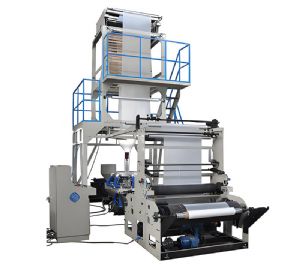
Blown Film Machine
Key line components: – Extruder: single or 3-layer, barrier screw, high-output. – Die: circular, with air ring and IBC. – Thickness gauge: beta or NIR, with optional AGC. – Folding board: for gusseting (if needed). – Seal bars: heated, with temperature and pressure control. – Perforating unit: blade or roller. – Cutting unit: guillotine or rotary. – Stacker or winder: for finished bags. – Reclaim system: granulator for edge trim. Process parameters: – Line speed: 150-200 m/min (extrusion). – Bag machine speed: synchronized, up to 300 bags/min. – Seal temperature: 130-180°C. – Seal pressure: 2-5 bar. – Dwell time: 0.5-2 sec. – Bag length: adjustable (e.g., 300-1200 mm). – Bag width: determined by lay-flat (300-1200 mm). Quality checks: – Seal strength: peel test. – Bag dimensions. – Perforation integrity. – Visual inspection for defects. In practice, the line is often run with high recycled content (up to 50%) to reduce cost. The operator must monitor the reclaim quality and adjust extrusion parameters. Regular maintenance of seal bars and cutting blades is essential. In conclusion, the garbage bag production line is a mature, high-volume system that delivers cost-effective bags for waste disposal, with continuous improvements in speed and automation.
