Advanced Frost Line Height Control and Its Effect on Film Properties and Stability 2026
The frost line height (FLH) is the vertical distance from the die exit to the point where the molten bubble solidifies. It is a critical process parameter because it determines the cooling history of the film, which in turn affects crystallization, orientation, and final properties. A lower FLH (faster cooling) results in smaller spherulites, which improves clarity and gloss, but also traps more orientation, leading to higher tensile strength and lower tear resistance. A higher FLH (slower cooling) allows more relaxation of oriented chains, which reduces haze and improves tear resistance but lowers tensile strength. The FLH also affects bubble stability; a lower FLH provides a shorter molten zone, making the bubble less susceptible to air currents, but it requires more cooling air, which can cause turbulence. The ideal FLH is a compromise that balances clarity, strength, and stability. For high-clarity packaging films, a FLH of 500-800 mm is common; for high-strength films (e.g., shrink), a FLH of 300-500 mm is preferred. The FLH is controlled by the cooling air flow rate and temperature, as well as the line speed and output. Increasing the cooling air flow lowers the FLH; decreasing raises it. IBC can also lower the FLH by cooling from the inside. The FLH must be maintained constant during production; any drift affects film properties. In summary, FLH is a key control variable that directly influences film quality and process stability. Its optimization is essential for producing film with the desired properties.
The control of FLH can be automated using a vision system that detects the frost line position and adjusts the blower speed or IBC flow to maintain the setpoint. The vision system uses a camera and image processing to identify the transition from glossy to matte. The control algorithm can be PID or model-based. The FLH also depends on the resin's crystallization temperature; higher crystallization temperature (e.g., HDPE) results in a lower FLH for the same cooling. The FLH must be adjusted when changing resins or products. The operator should regularly check the FLH using a scale or laser and adjust the cooling if needed. The FLH also affects the film's gauge profile; if the FLH is uneven (higher on one side), it indicates asymmetric cooling, which causes gauge bands. Therefore, the air ring must be centered and cleaned. In summary, FLH control is a dynamic process that requires both automation and operator vigilance. The use of advanced vision systems and automatic control can significantly improve consistency and reduce operator workload. By maintaining the FLH at the optimal level, converters can achieve the desired balance of clarity, strength, and stability for each product. In conclusion, frost line height is a fundamental parameter in blown film extrusion. Its precise control is essential for producing high-quality film consistently. The investment in FLH control technology pays off through improved product quality and reduced scrap.
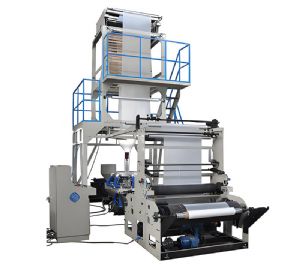
Blown Film Machine
Key effects of FLH: – Lower FLH (faster cooling): higher clarity, higher tensile, lower tear, more haze? Actually, lower FLH generally gives lower haze because smaller crystals scatter less light; but it also traps orientation, which can increase tensile. – Higher FLH (slower cooling): lower tensile, higher tear, higher haze (larger crystals), better clarity? Actually, slower cooling allows larger crystals, which scatter more light (higher haze), but reduces orientation, improving tear. – FLH stability is critical for uniform properties. Control methods: – Air ring blower speed (increase to lower FLH). – Air temperature (chilled air lowers FLH). – IBC flow (increase to lower FLH). – Line speed (increase raises FLH, if cooling unchanged). – Die temperature (increase raises FLH). – Resin change requires FLH adjustment. Troubleshooting: – If FLH is uneven, clean air ring and check centering. – If FLH is too high, increase cooling or reduce line speed. – If FLH is too low, reduce cooling or increase line speed. In conclusion, FLH is a sensitive parameter that must be carefully managed. Operators should be trained to recognize the signs of incorrect FLH (e.g., haze, instability) and take corrective action. With proper control, FLH becomes a tool for tailoring film properties to customer requirements.
