Advanced Food-Grade and Recyclable Mono-Material Packaging Film Extrusion 2026
The packaging industry is shifting towards mono-material films (e.g., all-PE or all-PP) to improve recyclability, while still requiring functional properties like barrier and sealability. For all-PE films, the challenge is achieving sufficient oxygen and moisture barrier without using EVOH or PA, which are not recyclable in PE streams. Solutions include using high-barrier PE grades with nano-fillers or coatings, or using co-extrusion with special tie layers that are PE-compatible. The extrusion line for mono-material packaging must be able to process these advanced PE grades, which may have higher melt strength and different rheology. The screw design must be optimized for these materials, and the temperature profile may need adjustment. The die must distribute the layers uniformly; for mono-material, the structure is often 3-layer with different PE grades (e.g., high-barrier sealant, structural core, and outer). The thickness gauge (NIR) must be calibrated for the specific PE grades. The line must also meet food-grade standards; the materials must be FDA-compliant, and the processing must avoid contamination. In summary, mono-material packaging film extrusion is a growing trend driven by sustainability. The line must be adapted to process the new PE grades and ensure barrier performance without compromising recyclability. The operator must be aware of the material's processing window and adjust parameters accordingly. The investment in line modifications (e.g., new screws, gauges) may be needed.
The barrier enhancement in mono-material films can be achieved by using high-density PE (HDPE) or by blending with barrier-enhancing additives. The extrusion line must be capable of processing HDPE, which requires higher melt temperatures and different screw design. The cooling must be optimized to achieve the required clarity and barrier. The layer structure can be designed to have a HDPE core for moisture barrier and a mLLDPE sealant. The tie layers are not needed if all layers are PE. The film's recyclability is ensured by using only PE-based materials. The line's control system must manage the different PE grades; the recipe management should store the settings for each product. In practice, mono-material films are gaining market share, and many converters are retrofitting their lines to produce them. In conclusion, the packaging film extrusion line is evolving to support sustainable mono-material solutions, enabling converters to meet regulatory and consumer demands for recyclable packaging without sacrificing performance.
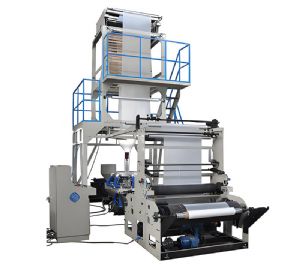
Blown Film Machine
Key mono-material PE structures: – 3-layer: mLLDPE (sealant)/HDPE (core)/LDPE (outer). – 5-layer: mLLDPE/tie? (not needed if all PE)/HDPE/PE/outer. – Materials: high-barrier PE, mLLDPE, HDPE, LDPE. – Additives: barrier enhancers (clay, silica). Process adaptations: – Screw design for HDPE and mLLDPE blends. – Higher melt temperature for HDPE (200-230°C). – Cooling optimization for clarity. – NIR calibration for new PE grades. – Food-grade compliance: FDA-listed materials. Quality targets: – OTR: <10 cc/m²/day. – WVTR: <1 g/m²/day. – Seal strength: >20 N/15mm. – Recyclability: PE content >95%. In practice, the line must be validated for both performance and recyclability. The operator must monitor the barrier properties regularly. In conclusion, mono-material packaging film extrusion is a key technology for sustainable packaging, and the extrusion line must be adapted to produce these films efficiently.
