Advanced Die Gap and Profile Control in Large-Diameter Blown Film Dies 2026
In large-diameter blown film dies (≥500 mm), achieving and maintaining a uniform die gap is critical for film gauge uniformity. The die gap is the annular opening between the inner and outer die lips, typically 0.5-2.5 mm. The gap must be precisely controlled around the circumference because any variation causes a thickness variation in the film. The most common adjustment mechanism is the thermal bolt, which consists of a bolt that expands when heated, moving the die lip to adjust the gap locally. The bolts are arranged around the circumference, typically 20-60 bolts, each with an independent heater and temperature sensor. The control system (AGC) heats or cools the bolts to correct thickness variations detected by the scanning gauge. The response time of thermal bolts is relatively slow (several minutes), so the AGC must be tuned to avoid overshoot. In large-diameter dies, the number of bolts must be sufficient to correct high-frequency variations; the rule of thumb is that the bolt spacing should be less than the width of the gauge scan's resolution. For example, a 600 mm die might have 40 bolts, each controlling about 15 mm of circumference. The die gap can also be adjusted globally by changing the die's overall temperature, which affects all bolts equally, but this is rarely used for profile control. Some advanced dies use piezoelectric actuators that provide faster response (milliseconds), enabling real-time correction of dynamic variations. However, piezoelectric actuators are more expensive and require high-voltage drivers. In summary, the die gap control system is the primary tool for achieving uniform film thickness. Its performance depends on the number of bolts, their thermal response, and the AGC algorithm's tuning. Regular maintenance – cleaning the bolts and checking their temperature calibration – is essential.
Profile control in large-diameter dies is further complicated by thermal expansion and melt flow distribution. The die's temperature must be uniform within ±1°C to prevent local viscosity variations that cause gauge bands. The die's heating zones must be individually controlled; large dies often have 8-16 temperature zones, each with its own thermocouple and heater. The die's internal melt distribution system (spiral mandrel) must also be designed to deliver the melt evenly; any asymmetry in the spiral channels will cause a permanent gauge profile. Therefore, the die's design and manufacturing quality are crucial. The die gap adjustment must compensate for any residual variations. The AGC algorithm typically uses a "profile" method: the thickness profile is measured, and the error at each bolt position is used to calculate a correction. The algorithm includes a deadband to avoid unnecessary adjustments, and it integrates the error over time to eliminate steady-state offset. The correction is applied as a temperature change to the bolt: heating expands the bolt, which moves the lip to increase the gap (thickening the film). The relationship between bolt temperature and gap change is non-linear and depends on the die's mechanical design; a calibration curve is usually provided by the manufacturer. In practice, operators can also manually adjust bolts to correct persistent gauge bands. The die should be cleaned regularly to prevent deposits that alter the gap. In summary, profile control in large-diameter dies is a sophisticated closed-loop system that requires precise hardware and well-tuned algorithms. Its performance directly determines the film's thickness uniformity, which affects material usage and downstream converting. Therefore, converters should invest in high-quality dies and AGC systems, and ensure that operators are trained to interpret gauge profiles and make manual adjustments when needed.
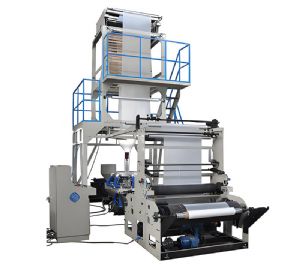
Blown Film Machine
Key factors for die gap and profile control: – Number of thermal bolts: more bolts allow finer correction. – Bolt response time: faster response improves control. – Temperature uniformity of the die: essential for baseline uniformity. – AGC tuning: gain, deadband, and integration time must be optimized. – Gauge scan speed and resolution: must match the bolt spacing. – Die cleanliness: deposits affect gap and heat transfer. – Resin viscosity: changes require re-tuning. – Environmental factors: ambient temperature fluctuations affect die temperature. Maintenance: – Regularly calibrate bolt heaters and thermocouples. – Clean the die lip and bolt heads. – Check for mechanical wear of the lip edge. – Verify the AGC algorithm's performance during production. In conclusion, advanced die gap and profile control are essential for producing high-quality film with tight thickness tolerances. The combination of precision mechanical design, thermal control, and advanced AGC algorithms allows converters to achieve gauge uniformity of ±2-3%, reducing material waste and improving customer satisfaction. As the demand for thinner, more uniform films grows, the role of die gap control becomes increasingly important.
