Advanced Die Diameter Selection and Its Impact on Bubble Stability and Film Properties 2026
The die diameter is a primary design parameter that determines the maximum lay-flat width and influences the achievable BUR and bubble stability. Larger die diameters allow wider films without requiring high BUR, which is beneficial because high BUR (above 4.0) often leads to bubble instability. For a given lay-flat width, a larger die diameter means a lower BUR, which generally improves bubble stability and reduces the risk of oscillation. However, larger dies require more precise temperature control and higher cooling capacity because the melt must be distributed over a larger circumference. The die diameter also affects the film's mechanical properties: a larger die with a lower BUR reduces the TD orientation, which can lower tear strength but improve clarity. Conversely, a smaller die with a higher BUR increases TD orientation, enhancing tear strength but reducing clarity. Therefore, the die diameter is chosen based on the desired balance of properties. For high-clarity films (e.g., shrink wrap), a larger die with lower BUR is preferred. For high-strength films (e.g., agricultural), a smaller die with higher BUR may be chosen. The die diameter also scales with output: for a given screw speed and melt flow, a larger die reduces the pressure drop, allowing higher output, but it also requires more cooling. The relationship between die diameter and output is non-linear; the flow rate through the die is proportional to the cube of the gap and the pressure gradient, but the circumference is proportional to the diameter. In practice, die diameters range from 50 mm (pilot) to 800 mm (wide agricultural). The selection must also consider the resin's melt strength; high-melt-strength resins can tolerate larger dies and higher BUR. In summary, die diameter is a strategic choice that affects nearly every aspect of the blown film process. It must be selected based on the target film width, required properties, and available cooling capacity. The decision is typically made during line design and cannot be easily changed later without significant cost.
The relationship between die diameter and bubble stability can be analyzed using the bubble's stress balance. A larger die diameter results in a larger bubble circumference for the same BUR, which increases the volume of air trapped and the surface area. This can make the bubble more susceptible to external disturbances, such as air currents, because the larger surface area has lower stiffness. However, a lower BUR for the same width reduces the circumferential stretch, which stabilizes the bubble. Therefore, for wide films, a larger die is almost mandatory to keep BUR in a stable range (2.5-3.5). The die diameter also affects the frost line height: a larger bubble requires more cooling air to achieve the same frost line height, so the air ring must be more powerful. The die's internal design (spiral mandrel) must be scaled to ensure uniform distribution; for large dies, the number of spirals must be increased to maintain distribution quality. The die's heating system must also be scaled; large dies have more heating zones and thermal bolts to maintain temperature uniformity. In summary, die diameter selection is a systems engineering task that must consider cooling, stability, and distribution. A poorly chosen die diameter can lead to chronic instability and poor gauge uniformity. Therefore, it is advisable to use simulation tools or consult with die manufacturers to determine the optimal diameter for a given product. In conclusion, the die diameter is a foundational parameter that sets the scope of the entire blown film line. Its selection requires a careful balance of width, stability, properties, and cooling capacity. By making the right choice, converters can achieve a stable process and high-quality film, while avoiding costly problems related to bubble instability.
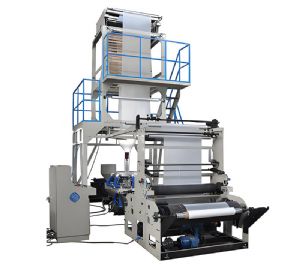
Blown Film Machine
Key considerations for die diameter selection: – Target lay-flat width: required width determines the minimum die diameter (for a given max BUR). – Stability: keep BUR in the range of 2.0-3.5 for most resins. – Cooling capacity: larger dies require more cooling air. – Output: larger dies allow higher output at the same pressure. – Resin type: high-melt-strength resins allow larger dies. – Film properties: higher BUR (smaller die) gives higher tear strength; lower BUR gives better clarity. – Cost: larger dies are more expensive and require more heating zones. – Space: larger dies require taller towers and more floor space. In practice, the die diameter is often chosen to be about 1/3 to 1/4 of the lay-flat width for a BUR of 2.5-3.0. For example, for a 1200 mm lay-flat, a die of 350-400 mm is typical. If higher BUR is desired for strength, a smaller die can be used, but stability must be verified. In conclusion, die diameter selection is a critical decision that should be based on a thorough analysis of product requirements and process capabilities. Consulting with experienced suppliers and using simulation tools can help avoid costly mistakes.
