Advanced Die Design and Melt Distribution in Film Blowing Machines for Uniform Gauge 2026
The die is the heart of the film blowing machine, transforming the melt stream from the extruder into a uniform annular tube. The die's design determines the flow distribution, which directly impacts film gauge uniformity and, in multi-layer lines, layer ratio accuracy. The most common die for single-layer film is the spiral mandrel die, where the melt enters from the side and flows through a spiral channel that gradually distributes it around the circumference. The spiral channel has a decreasing cross-section to ensure that the melt fills the entire circumference uniformly; the design parameters include the number of spirals (usually 2-6), the taper angle, and the land length. The die gap (typically 0.5-2.5 mm) is set by the die lip; it can be adjusted manually or automatically using thermal bolts. In multi-layer dies, the stack type is common, where each layer has its own spiral mandrel and the layers are combined near the die exit. The stack die allows independent temperature control for each layer, which is essential when processing polymers with different melting points (e.g., PE and PA). The feed block type combines the melt streams before the die; it is simpler but offers less independent control. The die material is usually tool steel or stainless steel; the inner surfaces must be polished to a mirror finish (Ra < 0.2 µm) to prevent melt adherence and die lines. The die also includes a central opening for the IBC tube. The heating system of the die is critical; it is divided into multiple zones (often 8-16) around the circumference, each with its own thermocouple and heater. Temperature uniformity across the die within ±1°C is necessary to achieve uniform melt viscosity and thus uniform flow. Thermal expansion bolts are used to adjust the die gap locally – heating a bolt expands it, reducing the gap (thickening the film) because it pushes the lip outward? Actually, the mechanism: the bolt is part of the die lip; heating expands the bolt, which moves the lip to increase the gap (thickens) or decrease? The common design: thermal bolts act on the lip to adjust the gap; heating expands the bolt, pushing the lip to close the gap (reduce thickness) or open? Typically, heating a bolt causes it to expand, which moves the die lip outward, increasing the gap, thus increasing film thickness. So to correct a thin spot, you heat the corresponding bolt. This is a simplified view; the exact relationship depends on the die design. In summary, the die is a precision instrument that requires careful design, manufacturing, and control to achieve uniform melt distribution and gauge.
The melt distribution inside the die is governed by the rheology of the polymer, which is non-Newtonian (shear-thinning). The design of the spiral channel must account for the viscosity's dependence on shear rate; the channel depth is usually optimized using computational fluid dynamics (CFD) simulations. The pressure drop across the die is a key parameter; it must be high enough to ensure a uniform velocity profile but low enough to avoid excessive melt temperature rise. Typical pressure drops range from 100 to 300 bar. In multi-layer dies, the viscosity of each layer must be matched as closely as possible; otherwise, the layers will flow at different velocities, causing interfacial instability (wave formation). This is particularly critical for EVOH and PA, which have higher viscosities than PE. Tie layers are often used to bridge the viscosity gap. The die's gap can be adjusted globally to change the film thickness for a given output; however, the local adjustment using thermal bolts is used for profile control. The response time of the thermal bolts is slow (minutes), so the automatic gauge control (AGC) system must be tuned to avoid overshoot. Some advanced dies use piezoelectric actuators for faster response (milliseconds), enabling real-time correction of high-frequency gauge variations. The die's land length (the parallel section at the exit) affects the flow stability; a longer land reduces melt fracture but increases pressure drop. The die design also includes a "choker" ring that can be adjusted to control the bubble's internal pressure and stabilize the bubble. In summary, the die is the final shaping element; its design and condition are critical for film uniformity. Regular cleaning of the die lip and inspection for scratches are essential maintenance tasks. Any damage to the die lip causes a permanent die line in the film. The die should also be protected from thermal cycling, which can cause warping. In conclusion, the film blowing machine's die is a masterpiece of precision engineering that directly determines the film's gauge profile. Its design must be matched to the specific resin and product requirements, and its operation requires careful temperature control and regular maintenance. Advances in die technology, such as active die gap control and multi-manifold designs, continue to push the boundaries of film uniformity and layer functionality.
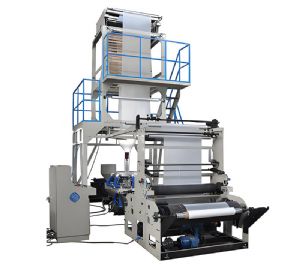
Blown Film Machine
Key die design parameters: Spiral channel depth and taper – affect flow distribution; deeper channels reduce pressure drop but may cause dead zones. Number of spirals – more spirals improve distribution but increase complexity. Land length – longer land improves flow stability but increases pressure. Die gap – determines the maximum thickness; larger gap allows thicker film but may require higher output. Heating zone count – more zones allow finer temperature control. Thermal bolt arrangement – more bolts allow finer profile correction. For co-extrusion, the die must have separate mandrels for each layer, with precise alignment to avoid delamination. The die should also include a pressure relief valve for safety. In operation, the die temperature should be set at the midpoint of the melt temperature range for the various layers. The operator should monitor the die pressure and temperature uniformity; any deviation indicates a problem. Regular use of a purging compound helps keep the die clean. In conclusion, the die is the most expensive single component of the film blowing machine, and its performance is directly linked to film quality. Investing in a high-quality die and maintaining it properly is essential for producing consistent, high-quality film.
