Advanced Diagnostics for Temperature Sensor and Heater Band Malfunctions in Blown Film Extruders 2026
Temperature control malfunctions in blown film extruders are common and can cause melt temperature deviations, affecting bubble stability and film quality. The system consists of thermocouples (or RTDs), heater bands, solid-state relays (SSRs), and PID controllers. A malfunction can be in the sensor (open circuit, short circuit, drift), the heater (open circuit, ground fault, reduced power), or the SSR (shorted or open). The first step in diagnosis is to determine whether the problem is in the sensor or the heater. Check the controller display: if it shows an error code (e.g., "open sensor" or "short sensor"), the sensor or its wiring is faulty. If the temperature reading is incorrect but no error, measure the actual barrel temperature with a handheld pyrometer or a backup thermocouple. If the actual temperature matches the display, the sensor is working; the problem is the heater or power supply. If the actual temperature differs, the sensor is likely drifting; replace it. For sensors, thermocouples (type J or K) can be checked for resistance (should be low, typically <100 ohms) and continuity. RTDs (Pt100) should have a resistance of 100 ohms at 0°C and increase with temperature (approximately 0.385 ohms/°C). Also, check for proper grounding; ground loops can cause erratic readings. In summary, systematic diagnosis using a multimeter and independent temperature measurement isolates the faulty component. The operator should keep spare sensors and heater bands in stock.
If the sensor is good, the heater or its control circuit is the issue. Heater bands are typically resistance heaters (e.g., 2000-5000 W at 240V). Check the heater resistance with a multimeter: it should be within ±10% of the rated value (e.g., 10-20 ohms for a 2000W heater at 240V). An open circuit indicates a broken heater; a low resistance indicates a short circuit (ground fault). Also, check the heater's insulation resistance to ground (should be >1 MΩ). The SSR is another common failure: it can fail shorted (heater always on, causing overshoot) or open (heater always off). To test the SSR, check the input signal from the controller (typically 4-20 mA or a DC voltage) and the output voltage (AC) across the heater. If the input is present but the output is zero when the controller calls for heat, the SSR is open; if the output is always present regardless of the input, the SSR is shorted. The SSR should be replaced with an identical or equivalent unit; ensure proper heat sinking. In practice, the controller's PID parameters may also need tuning if the sensor or heater replacement changes the system dynamics; auto-tuning can be performed. In summary, diagnosing temperature malfunctions requires a logical sequence: check the controller display, verify the sensor, check the heater, and then the SSR. Most issues are resolved by replacing the faulty component. Regular maintenance (checking heater resistance, cleaning sensor connections) can prevent many failures. In conclusion, a systematic approach to temperature sensor and heater band troubleshooting minimizes downtime and ensures stable extrusion temperatures.
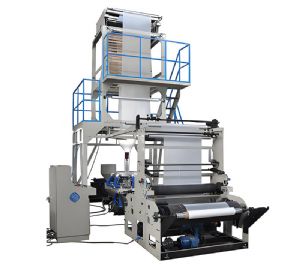
Blown Film Machine
Diagnostic steps for sensor: 1) Check controller error code; if open/short, inspect wiring and connector. 2) Measure sensor resistance with multimeter; compare to spec. 3) For thermocouple, measure millivolt output at temperature; compare to standard table. 4) For RTD, measure resistance and check linearity. 5) Check for ground loops; isolate sensor from barrel if needed. 6) Replace sensor if drift >2°C or out of spec. For heater: 1) Measure heater resistance; compare to rated value. 2) Check insulation resistance to ground; should be >1 MΩ. 3) Check voltage supply at heater terminals when controller calls for heat. 4) If voltage present but no current (clamp meter), heater is open; replace. 5) If current flows but temperature doesn't rise, check for poor thermal contact or damaged heater. For SSR: 1) Check input signal (4-20mA or DC voltage) from controller. 2) Check output voltage across SSR; if input present and output zero, SSR open; replace. 3) If output always present regardless of input, SSR shorted; replace. 4) Ensure SSR is properly heat-sinked; overheating causes early failure. Replacement and testing: 1) Power off and lock out before replacement. 2) Apply heat-conductive compound to new heater band. 3) Torque band evenly; avoid overtightening. 4) Perform auto-tuning of PID controller after replacement. 5) Verify temperature stability over 1 hour. In practice, the operator should keep a log of heater and sensor replacements; track failures to identify trends (e.g., frequent failure in a specific zone may indicate a wiring issue). In conclusion, advanced diagnostics for temperature sensor and heater band malfunctions enable quick, accurate repairs, maintaining precise melt temperature control essential for blown film quality.
