Advanced Determination of Screen Changer Replacement Interval: Pressure-Based and Throughput-Based Strategies 2026
The screen changer (or screen pack) protects the die by filtering out contaminants, gels, and carbonized particles from the melt. As the screen captures particles, the pressure drop across it increases, and the flow rate decreases if the extruder speed is constant. The replacement interval is the time or throughput before the screen becomes clogged and must be changed. The primary indicator is the pressure rise upstream of the screen changer. A typical baseline pressure (when the screen is new) is 50-150 bar, depending on resin and output. When the pressure rises by 30-50 bar (or 30-50% above baseline), it's time to change the screen, unless the maximum allowable pressure (e.g., 350-400 bar) is reached first. Alternatively, monitoring throughput: if the extruder speed must be increased to maintain output, the screen is clogging. The interval depends on resin cleanliness: virgin resin may allow 24-72 hours of operation; recycled or filled resin may require changes every 2-8 hours. In summary, the replacement interval should be based on pressure trend rather than fixed time. Operators should track the pressure rise rate and change the screen when the pressure reaches an alarm setpoint. This minimizes downtime (changing too early wastes screen material) and avoids quality issues (clogged screens cause surging and degradation).
Optimizing the screen pack design can extend the interval. The screen mesh size determines filtration fineness: finer mesh (e.g., 200 mesh) catches more particles but clogs faster; coarser mesh (e.g., 80 mesh) lasts longer but lets more contaminants through. A common practice is to use a graduated pack: coarse (20 mesh) on the upstream side, then medium (80 mesh), then fine (200 mesh) on the downstream side. This distributes the particle capture across layers, extending the interval. The screen area also matters: larger area reduces pressure drop for a given throughput, allowing longer intervals. Continuous screen changers (e.g., belt or rotary types) eliminate the need for stopping for changes; the screen is advanced incrementally, and the interval is effectively infinite, but they are more expensive. In practice, the operator should monitor pressure rise and change when the setpoint is reached. A log of pressure rise versus throughput helps predict intervals for each resin. In conclusion, the screen changer replacement interval is best determined by pressure monitoring and optimized by screen pack design, balancing filtration quality with uptime. Regular pressure sensor calibration is essential. In summary, a data-driven approach minimizes both premature changes and quality issues.
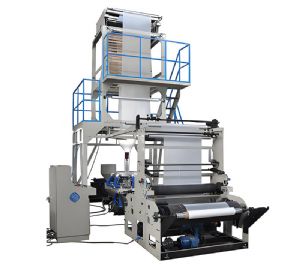
Blown Film Machine
Key indicators for screen change: Pressure rise: alarm at 30-50% above baseline; maximum limit at 80-90% of equipment rating. Throughput decline: if screw speed must increase >10% to maintain output. Melt temperature rise: increased pressure causes shear heating; if temperature rises >5°C. Visual inspection: when changing, check for contaminants; if heavy, shorten interval. Screen pack design: Mesh sequence: coarse to fine (e.g., 20/80/200 mesh). Surface area: larger area extends interval; use larger screen changers. Material: stainless steel with good strength. Continuous screen changers: Belt or rotary type; advanced automatically. Cost trade-off: Frequent changes: more labor, more screen material, more lost production (if manual). Infrequent changes: risk of clogging, surging, and quality issues. Optimal: change when pressure rise rate indicates imminent clogging. In practice, the operator should set alarm levels in the PLC and log screen change times. Use statistical process control to trend pressure rise. In conclusion, optimizing screen changer replacement interval reduces operating costs and improves melt quality, making it a key aspect of extruder management.
