Advanced Design of Experiments (DOE) and Response Surface Methodology for Blown Film Parameter Optimization 2026
Extrusion process parameter optimization is essential for achieving the desired film properties (clarity, strength, thickness uniformity) while maximizing output and minimizing scrap. A systematic approach using Design of Experiments (DOE) is far more efficient than one-factor-at-a-time trials. DOE allows the simultaneous variation of multiple parameters (e.g., BUR, melt temperature, cooling air flow, line speed) to identify main effects and interactions. A typical DOE for blown film might use a central composite design with 3 levels per factor. For example, BUR (2.5, 3.0, 3.5), melt temperature (190, 200, 210°C), and cooling air flow (80, 100, 120%) are varied, and responses (haze, tear strength, thickness variation) are measured. The data is used to build a Response Surface Model (RSM) that predicts the responses as a function of the parameters. The model can then be used to find the optimal settings that meet the target properties. The optimization can be multi-objective: e.g., maximize tear strength while keeping haze below 8% and thickness variation below 5%. In practice, the DOE is conducted during a dedicated trial run, and the statistical analysis is done using software (Minitab, JMP). The resulting optimal settings are then validated with confirmation runs. In summary, DOE and RSM provide a rigorous, data-driven approach to process optimization, reducing the number of trials and identifying the best combination of parameters. The operator can then use these settings as the baseline for production, with fine-tuning as needed. In conclusion, advanced DOE and RSM are powerful tools for blown film process optimization, enabling converters to achieve target film properties with minimal experimental effort and maximum confidence.
The DOE should also consider the impact of raw material variations (e.g., different resin batches) and environmental factors (ambient temperature). The optimal settings may need to be adjusted seasonally. The RSM can be updated with new data to improve the model. In practice, the operator should document the DOE results and create a "process window" (range of parameters that give acceptable properties) to allow flexibility. In conclusion, advanced statistical optimization using DOE and RSM is a key capability for converters seeking to improve product quality and process efficiency, reducing trial-and-error and accelerating product development.
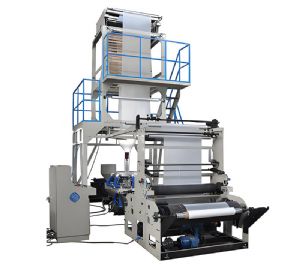
Blown Film Machine
DOE steps: 1) Define objectives (responses) and factors. 2) Select design (e.g., central composite, Box-Behnken). 3) Conduct trials in random order. 4) Measure responses. 5) Fit RSM model and analyze significance. 6) Use optimization to find factor settings. 7) Validate with confirmation runs. 8) Implement new settings. Key factors to vary: BUR, melt temperature, cooling air flow, line speed (or DDR), frost line height. Responses: haze, gloss, tear strength, tensile strength, thickness variation, output. Software: Minitab, JMP, Design-Expert. In practice, the DOE should be planned carefully to avoid confounding. The operator should use the results to create a process control plan. In conclusion, advanced DOE and RSM are essential for systematic blown film process optimization, leading to better quality, reduced scrap, and improved profitability.
