Advanced Cost Reduction and Material Utilization Strategies for Single-Layer Blown Film Lines 2026
Cost reduction is the primary driver for single-layer blown film lines, as they compete in price-sensitive commodity markets. The largest cost component is raw material (typically 60-80% of total cost). Therefore, reducing material usage or using lower-cost materials is the most effective strategy. This can be achieved by: (1) reducing film thickness (downgauging) without compromising performance, (2) using reclaimed or recycled material, (3) blending with lower-cost fillers (e.g., CaCO3), and (4) reducing scrap. Downgauging requires careful optimization of the process to maintain strength and toughness; using higher-performance resins (e.g., mLLDPE) can allow thinner films with the same properties. Reclaim integration is common: edge trim and start-up scrap are recycled back into the extruder feed, reducing virgin resin consumption. However, reclaim can degrade film properties if the ratio is too high; typically, 20-30% reclaim is acceptable for commodity films. The reclaim must be filtered to remove contaminants. Fillers can reduce cost, but they increase density and may affect mechanical properties; they require a more robust screw and barrel. Scrap reduction is achieved through better gauge control and process stability. In summary, cost reduction on single-layer lines is a multi-pronged approach that involves material substitution, reclaim, and process optimization. Each strategy has trade-offs that must be evaluated.
Material utilization also involves minimizing edge trim waste. Edge trim is the portion of the film that is cut off to achieve the final width; it can be 3-5% of the total output. Reducing the trim width by improving die and bubble stability can save material. The use of a variable-width die or a profile control can help. The reclaim system must be efficient; the trim must be conveyed cleanly to the granulator and fed back without causing contamination. The blending ratio of virgin to reclaim must be consistent; gravimetric feeders are recommended. The use of a melt filter in the reclaim stream can remove gels. In addition, the overall thickness profile should be optimized to have a flat profile with minimal edges; AGC can help. In summary, material utilization is about maximizing the usable film from the extruded melt. By minimizing edge trim, reclaiming scrap, and using thinner gauges, converters can significantly reduce material cost. The payback for investing in better gauge control and reclaim systems is usually short (less than 2 years). In conclusion, cost reduction and material utilization are the lifeblood of single-layer blown film operations. By implementing these strategies, converters can maintain profitability in competitive markets while also improving sustainability through reduced waste and recycled content.
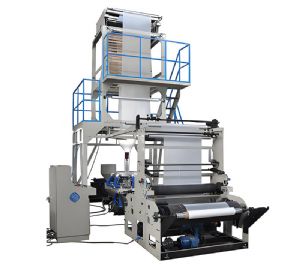
Blown Film Machine
Key cost reduction strategies: – Downgauging: reduce thickness while maintaining properties using advanced resins. – Reclaim integration: use edge trim and start-up scrap; typical ratio 20-30%. – Fillers: add CaCO3 or talc to reduce cost; may affect tear strength. – Gauge control: improve uniformity to reduce average thickness. – Edge trim reduction: optimize bubble stability and die profile. – Energy efficiency: use VFDs and heat recovery. – Process optimization: reduce scrap from startups and changeovers. Implementation steps: 1) Analyze current material cost and scrap rate. 2) Identify opportunities: reclaim, downgauging, fillers. 3) Test each option with trial runs; measure film properties. 4) Calculate cost savings vs. potential quality impact. 5) Implement best options; adjust screw and process as needed. 6) Monitor scrap rate and thickness variability. 7) Continuously improve. In conclusion, single-layer lines are well-suited for cost reduction strategies because of their simplicity. With careful implementation, converters can achieve significant cost savings while maintaining acceptable quality, ensuring competitiveness in the commodity film market. The combination of reclaim, gauge control, and optimized processing can reduce material usage by 10-20%, directly improving the bottom line.
