Advanced Corona Treatment and Surface Energy Control for Lamination Films 2026
Corona treatment is essential for lamination films to enhance adhesion of adhesives and primers. The corona discharge oxidizes the film surface, increasing its surface energy (dyne level) from 30-32 dyne/cm (untreated PE/PP) to 38-44 dyne/cm or higher. The treatment is applied inline, typically after the nip rolls and before winding. The corona unit consists of a high-frequency generator, an electrode (ceramic-covered bar), and a grounded roll. The power (watts) and line speed determine the treatment level. The operator must set the power to achieve the target dyne level; the level is measured using dyne test pens. The treatment decays over time, so the film should be laminated soon after treatment. The decay is faster for PE than PP. To minimize decay, the film should be stored in a cool, dry place. The corona treatment must be uniform across the width; any unevenness causes poor adhesion in spots. The grounded roll must be clean to ensure even treatment. In summary, corona treatment is a critical step for lamination films. The operator must monitor the dyne level regularly and adjust the generator power as needed. The system must be maintained (clean electrode, proper grounding) to ensure consistent treatment.
Over-treatment can cause surface degradation (haze, smoke) and reduce seal strength. The dyne level should be maintained within a target range. For most adhesive lamination, 40-44 dyne/cm is sufficient. The treatment power is proportional to line speed and width; the generator must have adequate capacity. In practice, the corona unit is often equipped with an automatic power control that adjusts power with line speed to maintain constant dyne level. The operator should check the dyne level at the start of each shift and after any speed change. The film's surface energy can also be tested by water contact angle; lower angle means higher energy. In conclusion, corona treatment and surface energy control are vital for lamination film performance. Proper equipment selection, maintenance, and monitoring ensure strong, reliable adhesion in the laminating process.
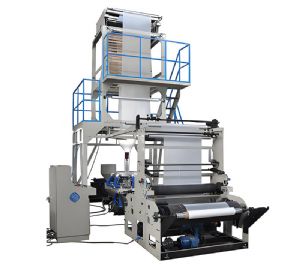
Blown Film Machine
Key corona parameters: – Power (W): depends on line speed, width, and target dyne. – Electrode gap: 1-3 mm. – Ozone extraction: essential. – Treatment level: 38-44 dyne/cm for PE, 42-48 for PP. – Decay rate: faster for PE; laminate soon after treatment. Process control: – Use dyne pens to check level. – Adjust power with speed changes. – Clean electrode and roll regularly. – Monitor for arcing or uneven treatment. – Check film for any smoke or haze (over-treatment). Quality tests: – Dyne level per ASTM D2578. – Contact angle (water). – Adhesion strength (peel test after lamination). – Visual inspection for treatment uniformity. In practice, the corona unit is a key component; its reliability is crucial. Regular maintenance (cleaning, checking connections) prevents downtime. In conclusion, advanced corona treatment and surface energy control are essential for producing lamination films with consistent adhesion, ensuring the quality of the final laminated product.
