Advanced Corona Surface Treatment: Principles, Power Control, and Dyne Level Management 2026
Corona surface treatment is a widely used method to increase the surface energy of plastic films, making them receptive to printing, coating, or lamination. The corona discharge is a high-voltage, high-frequency plasma that oxidizes the film surface, introducing polar groups. The treatment unit consists of a high-frequency generator, an electrode (ceramic-covered bar), and a grounded roll (silicone or rubber). The power (watts) applied to the electrode and the line speed determine the treatment level. The required power is proportional to line speed, film width, and the desired dyne increase. A common rule of thumb: Power (W) = (Speed in m/min) × (Width in m) × (Dyne increment) / 10. For example, for 150 m/min, 1.2 m width, target 42 dyne from 32 (increment 10), power ≈ 150 × 1.2 × 10 / 10 = 1800 W. The treatment level is measured using dyne test pens; the target dyne level is typically 38-44 dyne/cm for PE, 42-48 for PP. Over-treatment can cause surface degradation (haze, smoke); under-treatment results in poor adhesion. In summary, corona treatment requires precise power control to achieve the target dyne level. The operator should check the dyne level regularly and adjust the power if needed. The ozone generated by the corona must be extracted by a ventilation system to protect operators. In conclusion, advanced corona treatment control is essential for ensuring consistent adhesion in subsequent converting operations.
The treatment effect decays over time, so the film should be treated just before printing or lamination. The decay rate depends on the film material and storage conditions; for PE, the dyne level can drop by 5-10 units within days. To minimize decay, the film should be stored in a cool, dry place. The corona unit should be equipped with an automatic power control that adjusts power with line speed to maintain constant dyne level. The electrode should be cleaned regularly to remove polymer residues. In practice, the operator should check the dyne level at the start of each shift and after any speed change. In conclusion, advanced corona treatment control and management are essential for achieving consistent adhesion and high-quality printed or laminated films.
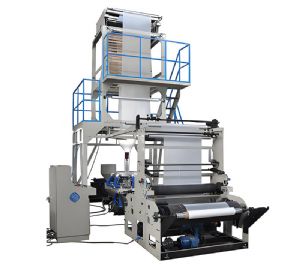
Blown Film Machine
Key corona parameters: Power: proportional to speed and width. Target dyne: 38-44 for PE, 42-48 for PP. Electrode gap: 1-3 mm. Ozone extraction: essential for safety. Power control: manual or automatic with speed. Treatment decay: minimize by treating just-in-time. Maintenance: Clean electrode and roll regularly. Check for arcing. In practice, the operator should use dyne pens to verify treatment level. In conclusion, advanced corona treatment is a key process for enhancing film adhesion, enabling high-quality printing and lamination.
