Advanced Cooling and Orientation Freeze in High-Speed Shrink Film Lines 2026
In high-speed shrink film lines (150-250 m/min), the orientation must be frozen rapidly to achieve high shrink force and clarity. The cooling system is critical; the air ring delivers high-velocity, chilled air to lower the frost line quickly. The IBC provides additional cooling from the inside. The frost line is typically set at 300-400 mm to ensure rapid solidification. The fast cooling reduces the time for polymer chains to relax, locking in the orientation. This results in higher shrink force and lower haze. However, too fast cooling can cause brittleness and reduce impact strength. Therefore, the cooling rate must be optimized for the specific blend. The use of chilled air (5-10°C) is common in high-speed shrink lines. The blower speed and IBC flow are controlled to maintain the frost line. The die temperature is set to ensure smooth melt flow without degradation. In summary, the cooling and orientation freeze are the key to high-speed shrink film production. The rapid quenching locks in the orientation, giving the film its shrink properties. The operator must balance cooling to achieve high shrink without sacrificing toughness.
The orientation freeze is also influenced by the polymer's crystallization rate. LDPE crystallizes slowly, allowing more relaxation, while LLDPE crystallizes faster, giving higher shrink. Blends are used to tune the shrink. The draw-down ratio (DDR) and BUR also affect the orientation freeze; higher orientation requires more rapid cooling to prevent relaxation. The line's control system must coordinate the cooling with the line speed; any mismatch causes shrink variation. In practice, the shrink film is tested immediately after production; any deviation prompts adjustment of cooling or speed. The film's clarity is an indicator of proper cooling; high haze may indicate insufficient cooling. In conclusion, the cooling and orientation freeze are the defining steps in shrink film production, and high-speed lines require advanced cooling systems and precise control to achieve the desired shrink performance.
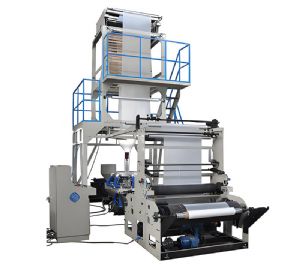
Blown Film Machine
Key cooling parameters: – Air temperature: chilled (5-15°C). – Air flow rate: high, to achieve low frost line. – IBC flow: balanced with external. – Frost line height: 300-400 mm. – Line speed: 150-250 m/min. – Melt temperature: 190-210°C. Impact on shrink: – Faster cooling → higher shrink force, lower haze. – Slower cooling → lower shrink, higher haze. – Too fast → brittleness. Optimization: – Start with standard settings; adjust cooling to achieve target shrink. – Monitor haze and impact strength. – Use DOE to find optimal cooling. In practice, the cooling system must be maintained regularly; any blockage in the air ring or IBC affects shrink. In conclusion, advanced cooling and orientation freeze are essential for high-speed shrink film lines, enabling production of high-clarity, high-shrink films for packaging.
