Advanced Cooling and Aerodynamic Optimization for Bubble Stability 2026
Bubble stability is heavily influenced by the cooling air flow's uniformity and turbulence. The air ring must deliver a symmetric, stable air stream. Turbulence from the air ring can excite bubble oscillations. To reduce turbulence, the air ring's lip gap and vane angles should be optimized. A dual-lip air ring with adjustable vanes allows independent control of cooling intensity and stability. The primary air stream provides cooling; the secondary stream stabilizes the bubble. The vane angle should be set to achieve a tangential flow that "wraps" around the bubble, reducing oscillation. The air velocity should be high enough for cooling but not so high that it causes turbulence. The use of a flow straightener (honeycomb) in the air ring can reduce turbulence. The IBC flow should be balanced with the external air to avoid creating a pressure differential that destabilizes the bubble. In summary, optimizing the air ring's aerodynamic design and balancing external and internal cooling are essential for bubble stability. The operator should perform a smoke test to visualize airflow and adjust vanes accordingly. The air ring should be cleaned regularly to prevent flow disruption. In conclusion, advanced cooling and aerodynamic optimization are key to achieving stable bubble operation, especially at high speeds and challenging resin conditions.
The interaction between external and internal cooling (IBC) must be balanced. If the IBC flow is too high relative to the external flow, the bubble may become too cold and brittle; if too low, the cooling is insufficient. The pressure balance is also important; the internal pressure must be slightly higher than external to keep the bubble inflated, but not so high that it stretches the bubble excessively. The operator should adjust the IBC flow to maintain a consistent frost line and bubble diameter. In practice, the use of a bubble camera and pressure sensors provides real-time feedback for tuning. In conclusion, aerodynamic and cooling optimization, combined with balanced IBC, is a powerful strategy for enhancing bubble stability, enabling reliable production at high speeds.
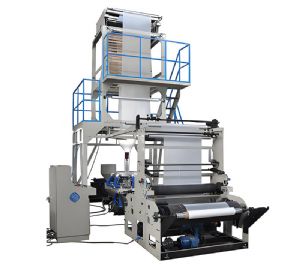
Blown Film Machine
Air ring optimization: Check centering and cleanliness. Adjust vane angles for tangential flow. Use smoke test to visualize symmetry. Reduce turbulence with flow straightener. Consider dual-lip design for better control. IBC balance: Match internal and external cooling. Maintain internal pressure slightly above external. Adjust flow to keep frost line stable. Monitor bubble diameter with sensors. Tuning: Start with conservative settings; adjust based on bubble behavior. Regular cleaning and maintenance. In practice, the operator should document settings for each product. In conclusion, advanced cooling and aerodynamic optimization are essential for bubble stability, and should be part of the routine process control strategy.
