Advanced Cooling Upgrade Strategies: IBC and Chilled Air for Output Increase in Blown Film 2026
The cooling system is often the primary bottleneck for output in blown film lines. The heat removal rate must match the heat input from the melt. By enhancing cooling, the line speed can be increased for the same thickness, or thicker film can be produced at the same speed. Two effective upgrades are IBC (Internal Bubble Cooling) and chilled air for the air ring. IBC adds a second cooling surface (inside the bubble), increasing the total heat transfer area by up to 100%. The combined external and internal cooling can increase the allowable line speed by 20-40%. Chilled air (5-15°C) increases the temperature difference between the melt and the cooling air, improving heat transfer by 20-30%. Together, IBC and chilled air can boost output by 40-60%. The investment for IBC (including chiller, blower, manifold) is typically $30,000-$80,000; for chilled air system (chiller, insulated ducts) $20,000-$50,000. The payback period is usually 6-18 months, depending on the output gain and product margin. In summary, IBC and chilled air are the most effective upgrades for increasing output, with rapid payback. They also improve gauge uniformity and clarity. The operator must manage the dew point to prevent condensation. The control system must be integrated with the line's PLC.
Implementation of IBC involves installing a distribution tube through the die center, a chiller for the internal air, and a blower with VFD. The internal air flow is controlled based on frost line feedback. Chilled air requires a chiller for the air ring blower intake, with insulated ducts to prevent condensation. Both upgrades require careful tuning to balance external and internal cooling. The operator should start with conservative settings and gradually increase output, monitoring bubble stability and film properties. The output gain can be calculated from the increased line speed at the same thickness. For example, if a line runs at 150 m/min without IBC and 200 m/min with IBC, the output increases by 33%. The energy cost of the chiller is offset by the higher output. In practice, many converters retrofit existing lines with IBC and chilled air to boost productivity. In conclusion, cooling upgrades are a proven, cost-effective way to increase output on blown film lines, delivering significant productivity gains with quick payback.
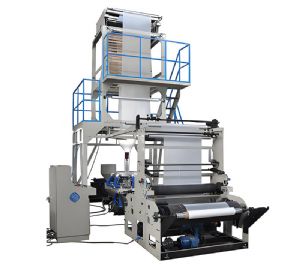
Blown Film Machine
IBC system components: Chiller: capacity based on output (10-30 kW). Blower: for internal air, with VFD. Distribution manifold: inside bubble. Pressure transducer: for internal pressure. Dew point sensor: to prevent condensation. Controller: integrated with line PLC. Chilled air system: Chiller for air ring blower intake. Insulated ducts and air ring. Temperature sensor. Flow control. Expected gains: IBC alone: +20-30% output. Chilled air alone: +10-20% output. Combined: +40-60% output. Clarity improvement: faster cooling reduces haze. Gauge improvement: symmetric cooling reduces variation. Payback: Investment: $50k-$130k. Output increase: 20-50% (e.g., from 300 kg/h to 420 kg/h). Additional revenue: $500/ton margin, 8000 h/year, 120 kg/h increase → $480,000/year extra. Payback < 4 months. Operational considerations: Monitor dew point; maintain below -10°C. Balance internal and external cooling to avoid brittleness. Adjust IBC flow with line speed changes. Use a chiller with sufficient capacity for peak summer conditions. In practice, the operator should run trials to find the optimal IBC and chilled air settings. In conclusion, IBC and chilled air are powerful upgrades that yield high returns, making them top priorities for converters seeking to increase output and competitiveness.
