Advanced Control and Tuning of IBC and Automatic Winder for High-Speed Blown Film Lines 2026
For a blown film line with IBC and automatic winder to operate at high speeds, the control systems must be precisely tuned and synchronized. The IBC control loop adjusts internal air flow to maintain the frost line height. The tuning parameters (gain, integration time) must be set based on the bubble's response time (typically 10-30 seconds). The winder's tension control must be integrated with the line speed; a load cell and dancer roll provide feedback. The transfer sequence must be timed with the line speed; the cut-off knife and core engagement must be rapid and reliable. The control system should have feedforward from line speed to IBC to anticipate cooling changes, and from line speed to winder tension to compensate for speed variations. In practice, the operator should perform step tests to determine the optimal PID settings for the IBC. For the winder, the transfer sequence should be tested with dummy rolls to ensure smooth operation. In summary, advanced tuning and synchronization are essential for high-speed lines with IBC and automatic winder. The operator must work with the supplier's service engineers during commissioning to set the parameters. Regular maintenance of sensors and actuators is critical. In conclusion, proper tuning and synchronization of IBC and automatic winder systems enable stable high-speed operation, maximizing the benefits of these upgrades and ensuring consistent film quality.
The IBC and winder controls should be integrated into the line's master PLC, with a unified HMI. The operator should be able to monitor the frost line, internal pressure, winder tension, and transfer status from a single screen. The system should have alarms for any deviation, such as low IBC flow or winder transfer failure. In practice, the operator should keep a log of settings and performance to fine-tune over time. In conclusion, advanced control and tuning of IBC and automatic winder are key to achieving the full potential of these upgrades, ensuring high-speed, stable, and quality production.
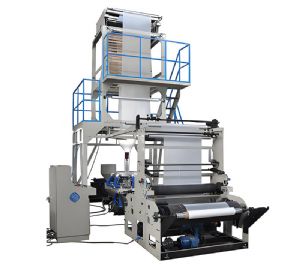
Blown Film Machine
IBC tuning parameters: Gain (proportional): adjust for response speed. Integral time: match bubble time constant (20-30 s). Derivative: low value to dampen. Feedforward: from line speed. Deadband: 5-10 mm on frost line. Winder tuning: Tension PID: gain based on load cell response. Transfer timing: cut-off knife and core engagement. Speed matching: during transfer, maintain line speed. Integration: PLC with unified HMI. Alarms for deviations. Maintenance: Calibrate sensors regularly. Clean IBC manifold. Check winder knives and rollers. Test transfer sequence periodically. In practice, the operator should work with the supplier to establish baseline settings and adjust as needed. In conclusion, advanced tuning and integration of IBC and automatic winder systems are essential for achieving high-speed, stable, and efficient blown film production, ensuring that the investment yields maximum returns.
