Advanced Control Algorithms and System Integration in Blown Film Systems 2026
A blown film system is a complex process with multiple interacting variables, making it an ideal candidate for advanced process control (APC). Traditional PID controllers are adequate for maintaining setpoints but struggle with large disturbances or interactions. Model Predictive Control (MPC) uses a dynamic model of the process to predict future outputs and compute optimal control actions. For example, MPC can anticipate the effect of a change in line speed on the frost line and adjust cooling air and internal pressure proactively, rather than reactively. The model is typically identified from step-test data and can be updated online (adaptive MPC). MPC can handle constraints (e.g., maximum heater power, minimum blower speed) and optimize for multiple objectives (e.g., maximize output while maintaining quality). Implementing MPC requires a powerful PLC or a dedicated industrial PC, and it requires significant engineering effort to develop the model. However, the benefits are substantial: improved thickness uniformity (±2% vs. ±4%), faster recovery from disturbances, and reduced operator intervention. Another advanced technique is auto-tuning of PID controllers, which automatically determines the optimal gain, integral, and derivative constants for each loop, reducing setup time and improving performance. The blown film system also includes cascade control, where the thickness gauge's average value is used to adjust the haul-off speed (outer loop), and the haul-off speed is used as the setpoint for the nip roll drive (inner loop). This structure improves response speed and stability. In summary, advanced control algorithms transform the blown film system from a manually tuned process to a self-optimizing machine, enhancing both quality and productivity.
System integration in a blown film system extends beyond the control loops to include the integration of the line with the plant's MES (Manufacturing Execution System) and ERP (Enterprise Resource Planning). The MES receives production orders and provides them to the line's control system, which then loads the recipe automatically. The MES also collects production data (output, scrap, energy consumption) and reports it to the ERP for costing and inventory. This integration enables paperless production and real-time decision-making. The line's sensors can also feed data to a cloud-based platform for remote monitoring and diagnostics by the manufacturer's service team. This reduces the need for on-site visits and speeds up problem resolution. The integration also includes the quality management system: the thickness gauge and other sensors provide statistical data that is used for SPC charts, and any deviation triggers an alarm. The system can also automatically adjust the AGC to keep the process in control. In summary, system integration turns the blown film system into a smart factory component, providing visibility and control across the entire value chain. This is the essence of Industry 4.0 for blown film. The benefits are reduced waste, improved traceability, and faster response to market changes. In conclusion, the modern blown film system is not just a set of machines but an integrated information-processing system. By investing in advanced control algorithms and seamless integration, converters can achieve a level of efficiency and quality that was previously unattainable. The upfront cost is significant, but the long-term competitive advantage justifies the investment, especially for high-value films where consistency is paramount.
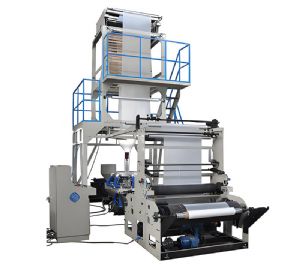
Blown Film Machine
Key advanced control features: – Model Predictive Control (MPC) for multi-variable optimization. – Adaptive PID with gain scheduling for non-linear processes. – Cascade control for fast inner loops. – Feedforward control to compensate for measured disturbances (e.g., ambient temperature). – Recipe management with automatic load and validation. – Data historian for trend analysis and troubleshooting. – Remote connectivity for manufacturer support. – Integration with MES for order management and reporting. – Integration with SPC for quality assurance. – Automatic alarm management with prioritization. In practice, the implementation of these features requires a well-defined project plan and close cooperation between the supplier and the plant's automation team. The control system should be designed with a modular architecture to allow future upgrades. Operators should be trained on the new features and given the ability to override the automation when needed. In conclusion, advanced control and system integration are the key differentiators for modern blown film systems. They enable higher consistency, lower scrap, and better responsiveness, ensuring that the plant remains competitive in a demanding market.
