Advanced Continuous Screen Changer Technology and Its Impact on Output and Quality 2026
Manual screen changers require stopping the extruder or interrupting the flow to change the screen, causing pressure fluctuations and output interruptions. Continuous screen changers allow filter screen replacement without stopping the melt flow, maintaining constant pressure and output. Two common types: belt-type (or leaf) and rotary-type. Belt-type uses a perforated steel belt with a filter medium; the belt advances, bringing a fresh section into the melt stream. Rotary-type has a rotating disc with multiple screen cavities; the disc rotates to bring a clean cavity into the flow while the dirty one is purged. Both types use hydraulic or mechanical drives. The primary advantage is stable melt pressure, which improves thickness uniformity and reduces scrap. The pressure fluctuation during screen advancement is minimal (typically <5 bar) compared to manual change (which can cause >50 bar drop). The screen media can be changed without operator intervention, reducing labor and downtime. However, continuous screen changers are more expensive and require more complex control. The replacement interval becomes a function of the screen media life and the advance rate; the system automatically advances when pressure rises to a setpoint. In summary, continuous screen changers are recommended for high-quality films where pressure stability is critical. They also allow processing of recycled material with high contamination without frequent manual changes. The investment is typically recovered through reduced scrap and increased output.
The screen media in continuous changers must be carefully selected for the application. Belt filters are available in various mesh sizes and can be cleaned offline (e.g., by backwashing) if designed for that. Rotary filters have individual cavities that can be purged and refilled with fresh media while the extruder runs. The seal between the rotating part and the stationary body is critical; leakage can cause melt loss or air ingress. The drive system must be robust to handle high pressure and torque. In practice, the operator monitors the pressure drop across the filter and the advance rate. The control system should alarm if the pressure remains high after advancement, indicating a worn seal or a stuck mechanism. Regular maintenance includes cleaning the filter media (if reusable) and checking the seal integrity. In conclusion, continuous screen changers are a valuable upgrade for blown film lines, providing consistent filtration and pressure stability, essential for high-quality film production and processing of difficult materials.
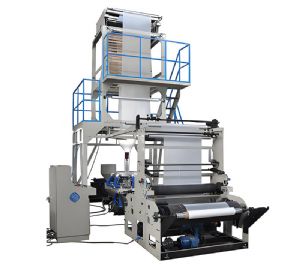
Blown Film Machine
Types of continuous screen changers: Belt type: perforated belt with filter medium; advances continuously. Rotary type: rotating disc with multiple cavities; indexes to next cavity. Both: allow on-the-fly screen change without flow interruption. Advantages: Stable melt pressure (±5 bar). Reduced scrap from pressure fluctuations. Reduced labor (no manual changes). Enables processing of recycled materials. Disadvantages: Higher capital cost (2-3x manual). More complex maintenance (seals, drive). Potential for seal leakage. Screen media: Belt: stainless steel mesh, can be cleaned. Rotary: individual screens, pre-loaded. Selection based on resin cleanliness. Installation: Typically after extruder, before melt pump (if used). Control: Pressure-based advancement. Maintenance: Check seals and drive regularly. Clean or replace media as needed. In practice, continuous screen changers are often used in high-output lines where downtime is costly. In conclusion, advanced continuous screen changer technology significantly enhances extrusion stability and quality, justifying the investment for high-volume, high-quality film production.
