Advanced Construction Vapor Barrier Film Machine: Heavy-Gauge HDPE Processing for Moisture Control 2026
A construction vapor barrier film machine produces thick (100-300 µm), wide (up to 4 m) films used to prevent moisture migration through walls, floors, and roofs. The film is typically made from HDPE or LDPE, with UV stabilizers for temporary exposure. The extrusion line is a heavy-duty system with a large extruder (100-150 mm), high-torque gearbox, and a bimetallic barrel for wear resistance. The die is large (400-800 mm) with a wide gap (1.5-3.0 mm). The cooling system includes a high-capacity dual-lip air ring and IBC to handle the thick film. The line speed is low (15-30 m/min), and output is 200-500 kg/h. The film's water vapor transmission rate (WVTR) must be very low (<0.1 perms, or <1 g/m²/day) to qualify as a Class I vapor retarder per ASTM E1745. This requires a defect-free film without pinholes; the line must have a pinhole detector (spark tester) to ensure integrity. The film is often black (with carbon black) for UV protection, or white for reflectivity. In summary, the vapor barrier line is optimized for heavy-gauge HDPE processing, with strict quality control for WVTR and puncture resistance. The operator must monitor melt temperature (200-230°C) and pressure; the high viscosity of HDPE requires careful temperature management. The film's thickness uniformity is critical; AGC helps. Regular WVTR testing is essential.
The film's mechanical properties must withstand installation handling; puncture resistance is critical. The addition of LLDPE or EVA can improve toughness but may increase WVTR. The line's screw must be designed for HDPE with a high compression ratio. The air ring must provide uniform cooling to minimize gauge bands. The collapsing frame and nip rolls must handle the thick film without deformation. The winder must have high torque to handle heavy rolls. In practice, the vapor barrier line often runs with recycled content (up to 30%) in the core layer to reduce cost, but the outer layers must be virgin to maintain barrier properties. The operator must ensure the reclaim is clean and dry. The film's WVTR is tested using a permeation analyzer. In conclusion, the construction vapor barrier film machine is a robust line that produces essential building materials for moisture control, ensuring energy efficiency and durability of structures.
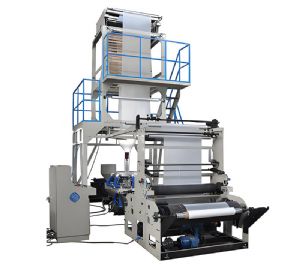
Blown Film Machine
Key film properties: – WVTR: <0.1 perms (Class I). – Thickness: 100-300 µm. – Width: up to 4 m. – Tensile strength: >25 MPa. – Puncture resistance: high. – UV stability: for temporary exposure (up to 6 months). Process parameters: – Resin: HDPE (density >0.94) or LDPE/LLDPE blends. – Melt temperature: 200-230°C. – BUR: 2.5-3.0. – Line speed: 15-30 m/min. – Cooling: air ring + IBC. – Additives: UV stabilizers (2-5% masterbatch), carbon black for color. Quality tests: – WVTR per ASTM E96. – Pinhole detection (spark tester). – Tensile, tear, puncture. – Gauge uniformity. In practice, the line must be validated for the specific building code requirements (e.g., ASTM E1745). The operator must monitor the WVTR and adjust process parameters if needed. In conclusion, the construction vapor barrier film machine is a specialized line that produces high-performance moisture barriers for building envelopes, contributing to energy efficiency and structural integrity.
