Advanced Causes of Poor Optical Clarity and High Haze in Blown Film: Surface Roughness, Internal Scattering, and Cooling Effects 2026
Optical clarity (or haze) in blown film is determined by two main factors: surface roughness (which scatters light at the film surfaces) and internal scattering (caused by crystallites, density variations, or additives). Surface roughness arises from the crystallization process; as the molten film cools, polymer chains crystallize into spherulites, which protrude slightly at the surface, creating micro-roughness that scatters light. The size of the spherulites depends on the cooling rate: faster cooling produces smaller spherulites, which reduce surface roughness and haze, but may also freeze in orientation. Slower cooling allows larger spherulites to grow, increasing surface roughness and haze. Internal scattering is caused by spherulites, additives (e.g., slip agents, anti-block, fillers), and density fluctuations (e.g., gels or unmelted particles). The haze is the percentage of transmitted light that is scattered; for blown film, typical haze is 5-15%, while cast film can achieve <2% due to rapid quenching. In summary, haze is primarily a function of cooling rate and the resulting crystallinity. To improve clarity, the cooling rate must be increased (lower frost line, higher airflow, chilled air, IBC) to reduce crystallite size. The use of resins with narrow molecular weight distribution (e.g., mLLDPE) also reduces haze because they form smaller spherulites. Additives that act as nucleating agents can also reduce spherulite size.
The cooling rate is controlled by the air ring (external) and IBC (internal). Increasing the air flow, using chilled air, and lowering the frost line all increase the cooling rate, reducing haze. However, excessive cooling can cause brittleness and reduce tear strength. The trade-off must be optimized. The BUR also affects haze; higher BUR stretches the film, thinning it and increasing surface roughness, which can increase haze. Therefore, for high-clarity films, a lower BUR (2.0-2.5) is preferred. The melt temperature also plays a role; higher melt temperature allows more relaxation before cooling, which can reduce orientation and haze, but too high causes degradation. The die temperature uniformity is critical; any non-uniformity causes local cooling variations, leading to haze bands. In practice, the operator should use a design of experiments (DOE) to find the optimal cooling and BUR for the desired clarity. In-line haze measurement (e.g., haze meter) provides feedback. In summary, poor clarity is usually due to insufficient cooling or too high BUR. By optimizing these parameters and selecting appropriate resins, haze can be reduced significantly. In conclusion, optical clarity in blown film is a result of careful control of cooling, BUR, and material selection; understanding the mechanisms enables targeted improvements.
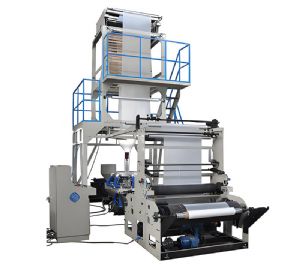
Blown Film Machine
Key factors affecting haze: Cooling rate: faster cooling → smaller spherulites → lower haze. BUR: higher BUR → more surface stretching → higher haze. Melt temperature: higher temp → more relaxation → lower haze (up to limit). Resin type: mLLDPE < LLDPE < LDPE in clarity (mLLDPE best). Additives: slip agents, anti-block increase haze; use minimal. Die temperature: uniformity is key; variations cause haze bands. Film thickness: thinner films generally have lower haze (less internal scattering). Measurement: Haze meter per ASTM D1003. Gloss meter per ASTM D523. Improvement strategies: Increase air ring airflow or use chilled air. Add IBC to enhance cooling. Reduce BUR to 2.0-2.5. Use mLLDPE or blends with high clarity. Minimize additive levels. Optimize melt temperature (190-210°C). Ensure die temperature uniformity (±1°C). Use a nucleating agent to reduce spherulite size. Troubleshooting: If haze is uniform, adjust cooling or BUR. If haze is in bands, check die temperature uniformity or air ring symmetry. If haze increases with production time, check for die lip contamination. In practice, the operator should regularly measure haze and adjust parameters. In conclusion, poor optical clarity is usually correctable with process adjustments; understanding the root causes enables systematic improvement.
