Advanced Calculation and Prediction of Output Capacity for Different Resins and Products 2026
The theoretical output capacity of a blown film extruder can be calculated from the screw's geometry and speed. For a single-screw extruder, the output (Q) is given by the formula: Q = (π² D² N h sin φ cos φ) / 2 - (π D h³ ΔP) / (12 η L), where D is the screw diameter, N is the screw speed, h is the channel depth, φ is the flight angle, ΔP is the pressure difference, η is the melt viscosity, and L is the length of the metering zone. The first term is the drag flow (positive), and the second term is the pressure flow (negative, backflow). In practice, the actual output is 70-90% of the theoretical due to leakage and imperfect melting. The formula shows that output increases with screw speed (N) and decreases with pressure (ΔP) and viscosity (η). Therefore, to increase output, one can increase screw speed or reduce die pressure (e.g., by using a larger die gap or a melt pump). The specific output (kg/h per RPM) is a useful metric; it is typically 0.5-1.5 kg/h per RPM for PE lines, depending on screw size. The output also depends on the resin's density; for HDPE (density ~0.96), the output is higher by weight than for LDPE (density ~0.92) at the same volumetric flow. The formula provides a good estimate, but actual output must be measured. The prediction of output for a new resin can be done by using the resin's viscosity curve and adjusting the formula. In summary, the calculation of output capacity is based on fluid mechanics, but the actual output is influenced by many practical factors, such as screw wear, barrel temperature, and feed rate. Regular measurement of output at different screw speeds provides a calibration curve that can be used for prediction and troubleshooting.
For multi-layer lines, the output capacity is the sum of the individual extruders' outputs, but each extruder's output must be matched to the required layer ratio. The total output is limited by the smallest extruder; if the barrier layer extruder cannot produce enough melt, the total output is limited. Therefore, when designing a multi-layer line, the extruders are sized to meet the target layer percentages. The output capacity can be predicted using the same formulas for each extruder, with the resin's viscosity and density. The melt pump's displacement must be chosen to match the extruder's maximum output. In practice, operators measure the output of each extruder by collecting the melt from the die (or by weighing the film and knowing the layer ratio). The total output is then calculated. The prediction of output capacity for a product change is based on the screw speed and the specific output for that resin. The specific output can be determined from a previous run. In summary, the prediction of output capacity is a combination of theoretical calculation and empirical measurement. By maintaining a database of specific outputs for different resins, operators can quickly estimate the output for a new product, aiding in production planning. The use of gravimetric feeders also provides real-time output data, which is more accurate than screw speed-based estimates. In conclusion, understanding and predicting output capacity is essential for production management. It allows converters to set realistic targets, plan material requirements, and identify process inefficiencies. The combination of theoretical knowledge and practical measurement provides a robust foundation for optimizing output.
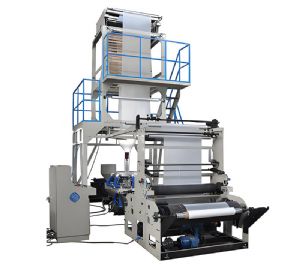
Blown Film Machine
Key variables in output formula: – Screw diameter (D) – Screw speed (N) – Channel depth (h) – Flight angle (φ) – Pressure (ΔP) – Viscosity (η) – Metering length (L) – Leakage factor (typically 0.8-0.95) Practical estimation: – Measure output at a known screw speed and resin. – Calculate specific output (kg/h per RPM). – For a new resin, adjust for density and viscosity difference. – For a new product, estimate output from specific output and required screw speed. – Use gravimetric feeders for real-time output measurement. – Monitor melt pressure to detect changes in output. In conclusion, output capacity prediction is a valuable tool for production planning. By combining theoretical formulas with empirical data, converters can accurately estimate their production capability and optimize their operations.
