Advanced Calculation and Control of Blow-up Ratio (BUR) in Blown Film: Formula, Measurement, and Process Interaction 2026
The blow-up ratio (BUR) is defined as the ratio of the bubble diameter at the frost line to the die diameter. Since directly measuring the bubble diameter is impractical in production, BUR is calculated from the lay-flat width (the width of the collapsed tube) using the geometric relationship: Lay-flat width = (π × Bubble Diameter) / 2. Rearranging, Bubble Diameter = (2 × Lay-flat width) / π. Substituting into the BUR definition gives: BUR = (2 × Lay-flat width) / (π × Die Diameter). For example, if the die diameter is 250 mm and the measured lay-flat width is 1200 mm, then BUR = (2 × 1200) / (π × 250) = 2400 / 785.4 = 3.06. This is the standard formula used by operators. The lay-flat width is typically measured at the collapsing frame or after the nip rolls using a ruler or an online ultrasonic sensor. The die diameter is a fixed machine parameter, known from the die specifications. The BUR can also be calculated from the bubble circumference if measured with a laser sensor, but lay-flat width is more common. The accuracy of the BUR calculation depends on the precision of the lay-flat measurement; a 5 mm error in width causes a ~0.01 error in BUR for a 250 mm die. For automatic control, the lay-flat width sensor provides continuous feedback to the internal pressure control loop, which adjusts the bubble diameter to maintain the target BUR. In summary, calculating BUR is straightforward using the formula, but accurate measurement of lay-flat width is essential for process control. The operator should measure lay-flat width at a consistent point (e.g., just after the nip) to avoid variations from cooling shrinkage. The target BUR is set based on the desired film properties and stability, and the internal pressure is adjusted to achieve it.
The BUR is not an independent variable; it interacts with the draw-down ratio (DDR) to determine the total orientation and final film thickness. DDR is the ratio of the haul-off speed to the melt exit speed at the die. The film thickness is inversely proportional to the product of BUR and DDR: Thickness ∝ 1 / (BUR × DDR). Therefore, for a given target thickness, increasing BUR requires decreasing DDR (by reducing haul-off speed) to maintain thickness, or vice versa. The balance of MD and TD orientation is determined by the ratio of DDR to BUR; a balanced film (MD≈TD properties) is achieved when DDR and BUR are roughly equal (or product around 10-15). In practice, operators first set the target thickness by adjusting the haul-off speed (DDR), then adjust the BUR (via internal pressure) to achieve the desired lay-flat width and TD properties. The BUR also affects bubble stability: higher BUR (>4.0) tends to cause oscillation, while lower BUR (<2.0) gives less TD orientation. The optimal BUR for most PE films is between 2.5 and 3.5. In summary, BUR calculation is the first step, but its proper use requires understanding its interaction with DDR and its effect on film properties and stability. The operator should document the BUR and DDR settings for each product recipe to ensure repeatability. Automatic control systems can maintain BUR by adjusting internal pressure based on lay-flat width feedback, while also adjusting haul-off speed to maintain thickness. In conclusion, accurate BUR calculation and control are fundamental to blown film production, enabling consistent film width, thickness, and balanced properties.
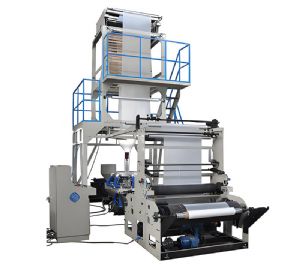
Blown Film Machine
Step-by-step BUR calculation: 1) Measure lay-flat width (W_lf) in mm at the collapsing frame or after nip. 2) Note die diameter (D_die) in mm from specifications. 3) Compute BUR = (2 × W_lf) / (π × D_die). 4) If using a sensor, ensure calibration and consistent measurement point. 5) Check that the bubble is symmetric; if not, the calculated BUR is an average. 6) Adjust internal pressure to increase or decrease BUR; monitor lay-flat width change. 7) Recalculate BUR after each adjustment. 8) For multi-layer films, the same BUR applies to all layers, as they are co-extruded. Impact of BUR on properties: Higher BUR → higher TD tear, impact, but lower clarity and stability. Lower BUR → higher clarity, stability, but lower TD strength. BUR also affects lay-flat width: for a given die, width ∝ BUR. Therefore, BUR is the primary control for film width. Interaction with DDR: Thickness = (Output / (Line speed × Width × Density)) × 1000; also Thickness ∝ 1/(BUR × DDR). To maintain thickness when changing BUR, adjust haul-off speed (DDR) accordingly. For example, increasing BUR by 10% requires decreasing DDR by ~9% to keep thickness constant. Use the formula: New DDR = Old DDR × (Old BUR / New BUR). In practice, operators often set BUR based on the target lay-flat width, then adjust haul-off speed to achieve the target thickness. Regular verification of lay-flat width and thickness ensures the BUR and DDR are correctly set. In conclusion, mastering BUR calculation and its interaction with DDR is essential for efficient blown film production, enabling precise control of film dimensions and properties.
