Advanced Blower Control and Pressure Regulation for Air Ring Stability 2026
The air ring's performance depends on a stable and controlled air supply, which is provided by a blower (centrifugal or regenerative) with a variable frequency drive (VFD). The VFD adjusts the blower speed to maintain the desired air flow or pressure. The control system can be based on a pressure setpoint (maintaining a constant pressure) or a flow setpoint (maintaining a constant flow). Pressure-based control is more common because the air ring's pressure drop is relatively constant for a given setting, and pressure is easier to measure. A pressure transducer is installed near the air ring inlet; the controller compares the measured pressure to the setpoint and adjusts the blower speed via the VFD. The pressure setpoint is determined during process setup; it is typically 2-5 kPa (2000-5000 Pa). The control loop must have fast response to compensate for changes in line speed or bubble pressure; a slow response can cause frost line fluctuations. The blower's inlet may have a filter to prevent dust, and a silencer to reduce noise. In summary, the blower control system is a critical component for maintaining consistent cooling. The use of a VFD with PID control allows precise pressure regulation, ensuring that the air ring delivers a constant cooling intensity. Regular maintenance of the blower (bearing lubrication, filter cleaning) is essential to prevent performance degradation. The operator should monitor the pressure reading and the blower speed; a deviation from the normal range indicates a problem (e.g., clogged filter, leak, or worn blower).
The pressure regulation strategy must account for the non-linear relationship between blower speed and flow/pressure. Centrifugal blowers have a characteristic curve: pressure increases with speed, but the flow also increases. The system curve (air ring + ducts) interacts with the blower curve to determine the operating point. The VFD control adjusts the speed to move the operating point to the desired pressure. The PID gains must be tuned to avoid hunting (oscillation). The deadband should be set to prevent unnecessary adjustments. In some lines, a flowmeter is used instead of pressure, providing a more direct measure of cooling, but flowmeters are more expensive and sensitive to gas composition. The pressure transducer must be calibrated regularly. The blower's motor current is also monitored; an increase in current at constant pressure indicates a blockage in the air ring. In summary, advanced blower control is essential for maintaining cooling consistency. The use of a VFD with a well-tuned PID controller provides stable pressure, which translates to stable frost line and film properties. The integration of the blower control with the line's master speed control allows coordinated changes when line speed changes. In conclusion, blower control and pressure regulation are key to achieving stable blown film production. By ensuring a constant air supply, converters can eliminate a major source of variability, leading to improved film quality and reduced scrap.
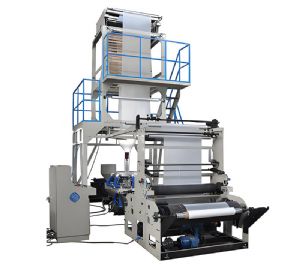
Blown Film Machine
Key components: – Blower: centrifugal or regenerative, sized for max flow and pressure. – VFD: for speed control, with input from pressure transducer. – Pressure transducer: range 0-10 kPa, accuracy ±0.5%. – PID controller: integrated in PLC or stand-alone. – Inlet filter: to prevent dust. – Silencer: to reduce noise. – Ducting: smooth, with minimal bends. Control tuning: – Set proportional gain to provide quick response without oscillation. – Integral gain to eliminate steady-state error. – Derivative gain to dampen overshoot (often low). – Deadband: set to 1-2% of setpoint to avoid excessive adjustments. – Update rate: 1-2 seconds. Maintenance: – Clean inlet filter monthly. – Check bearing lubrication quarterly. – Inspect ducting for leaks annually. – Calibrate pressure transducer with a reference. – Monitor motor current for signs of wear. In conclusion, a well-designed and maintained blower control system is essential for reliable air ring operation. It ensures consistent cooling, enabling stable bubble formation and high-quality film production.
