Advanced Blending and Orientation Control for HDPE/LLDPE Films in Blown Film 2026
HDPE films, while stiff and strong in the machine direction (MD), have low tear strength in the transverse direction (TD) due to the high molecular orientation from the low BUR. To improve TD tear strength, HDPE is often blended with LLDPE (10-40%). LLDPE has higher melt strength and better tear resistance, and the blend combines the stiffness of HDPE with the toughness of LLDPE. The optimal blend ratio depends on the application; for grocery bags, 20-30% LLDPE is common, providing a good balance of stiffness and tear resistance. The blend must be homogenized in the extruder; a barrier screw with a mixing section is recommended. The processing temperature should be set to accommodate both resins; typically, the blend is processed at 200-220°C. The BUR can be slightly higher than for pure HDPE (2.5-3.0) because the LLDPE improves bubble stability. The orientation balance is controlled by the BUR and DDR; the blend allows a higher BUR without instability. In summary, blending HDPE with LLDPE is an effective way to improve TD tear strength while maintaining stiffness. The machine must be capable of processing the blend uniformly, and the process parameters must be adjusted to optimize the blend's properties. The operator should monitor the film's tear strength and adjust the blend ratio or BUR accordingly. In practice, the blend is often used for all HDPE bag lines to enhance performance.
The orientation control in HDPE/LLDPE blends is more forgiving than pure HDPE. The LLDPE provides higher melt strength, allowing a higher BUR (2.5-3.0) which increases TD orientation and tear strength. The DDR can be adjusted to balance MD and TD properties. The goal is to achieve a balanced film where the MD and TD tear strengths are similar. The blend ratio and the BUR are the primary levers. The film's stiffness decreases slightly with LLDPE addition, but the improvement in tear resistance is significant. The optical properties (clarity) may improve because the LLDPE helps reduce haze. In practice, the operator uses a DOE to find the optimal blend ratio and BUR for the target film. The thickness gauge and tear tester are used for feedback. In summary, blending HDPE with LLDPE provides a cost-effective way to improve film performance. The line must be able to handle the blend's rheology and the adjusted process parameters. In conclusion, the HDPE/LLDPE blend is a standard in the bag industry, offering a balance of stiffness, tear strength, and cost. The blown film line must be optimized for this blend to achieve consistent quality.
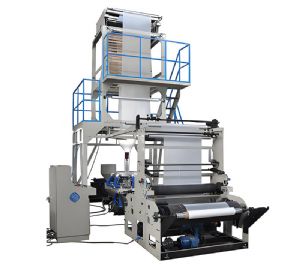
Blown Film Machine
Key blend parameters: – LLDPE content: 10-40%; higher improves tear but reduces stiffness. – BUR: 2.5-3.0 for blends; higher than pure HDPE. – Melt temperature: 200-220°C. – Screw: barrier with mixing section for homogenization. – Additives: slip and anti-block for handling. – Tear strength target: MD and TD balanced. Optimization process: 1) Select base HDPE and LLDPE grades. 2) Test blends at 10, 20, 30% LLDPE. 3) Measure stiffness (tensile modulus), tear strength, and haze. 4) Choose blend ratio that meets requirements. 5) Adjust BUR to achieve target tear balance. 6) Verify with production trial. 7) Document settings. In practice, the blend ratio is often adjusted based on raw material cost and availability. The line's screw must be able to handle the blend without surging. Regular monitoring of tear strength is essential. In conclusion, HDPE/LLDPE blending is a key technology for producing high-performance bags. The blown film line must be flexible to accommodate different blend ratios and process settings.
