Advanced Biodegradable Mulch Film Extrusion: Processing PLA/PBAT Blends 2026
Biodegradable mulch films are gaining traction as an alternative to traditional PE films, reducing plastic waste in agriculture. The main materials are PLA (polylactic acid) and PBAT (polybutylene adipate terephthalate), which are compostable. However, these materials have different processing characteristics: PLA is heat-sensitive and requires drying (moisture <0.05%), while PBAT is more flexible but has lower melt strength. The extrusion line must be adapted: the screw should have a lower compression ratio (2.0-2.5:1) to reduce shear heating, and the L/D ratio is typically shorter (24-28:1) to minimize residence time. The barrel temperature is lower (160-190°C) to avoid degradation. The die must be heated uniformly, and the cooling must be efficient to prevent sticking. The BUR is typically 2.0-2.8 to maintain bubble stability. The line speed is moderate (30-60 m/min). The film's mechanical properties are lower than PE, but sufficient for many applications. The degradation rate is controlled by the blend ratio and additives. In summary, biodegradable mulch film extrusion requires modifications to the standard PE line, including screw design, temperature control, and drying systems. The operator must be trained to handle these new materials, which have narrower processing windows. The line can often be converted from PE to biodegradable with appropriate changes.
The drying of PLA is critical; a desiccant dryer with a dew point of -40°C is required. The conveying system must be sealed to prevent moisture pickup. The PBAT may also need drying if hygroscopic. The blend ratio affects the film's properties; typical ratios are 50/50 to 70/30 PLA/PBAT. The additives include nucleating agents to improve clarity and processing aids. The film's thickness is similar to PE mulch (15-30 µm). The line's AGC can maintain thickness uniformity. The film's compostability is tested per ASTM D6400. In practice, the line must be thoroughly purged when switching from PE to biodegradable to avoid cross-contamination. The recycling of edge trim is possible but requires separation. In conclusion, biodegradable mulch film extrusion is a growing niche that requires line modifications and careful process control to produce films that meet agricultural and compostability requirements.
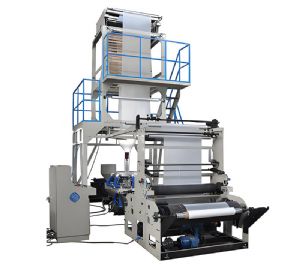
Blown Film Machine
Key material properties: – PLA: heat-sensitive, requires drying, lower melt strength. – PBAT: flexible, lower modulus, better melt strength. – Blend ratio: 50/50 to 70/30 PLA/PBAT. – Additives: nucleating agents, processing aids, UV stabilizers. Process adaptations: – Screw: low compression ratio (2.0-2.5:1), shorter L/D (24-28:1). – Barrel temperature: 160-190°C. – Drying: desiccant dryer, dew point -40°C. – BUR: 2.0-2.8. – Cooling: efficient, to prevent sticking. – Purging: thorough when switching from PE. Quality targets: – Thickness: 15-30 µm. – Tensile strength: comparable to PE. – Tear strength: lower. – Compostability: per ASTM D6400. In practice, the line must be validated for the specific biodegradable resin. Regular monitoring of moisture and melt temperature is essential. In conclusion, the agricultural mulch film machine can be adapted for biodegradable materials, offering a sustainable alternative for farmers, but requires careful process engineering and operator training.
